


AymurAI: Structuring Judicial Data on Gender-Based Violence

Argentina
Other
Justice and Governance
Implementing Organisation
DataGénero
Argentina, Buenos Aires
Deployed across Argentina, Chile, and Costa Rica
Implementing Point of Contact
Vana Feldfeber
Author / Researcher, DataGénero
Contributor of the Impact Story
UN Women
Year of implementation
2022
Problem statement
In Latin America, knowledge about gender-based violence is trapped in unstructured judicial documents, accessible only through slow manual processes. Weak transparency and accountability in judicial institutions contribute to public distrust. Data systems focusing narrowly on feminicide obscure the broader spectrum of gender-based violence. The absence of traceable, high-quality data on GBV is a pressing structural issue that limits prevention and oversight.
Submission Overview
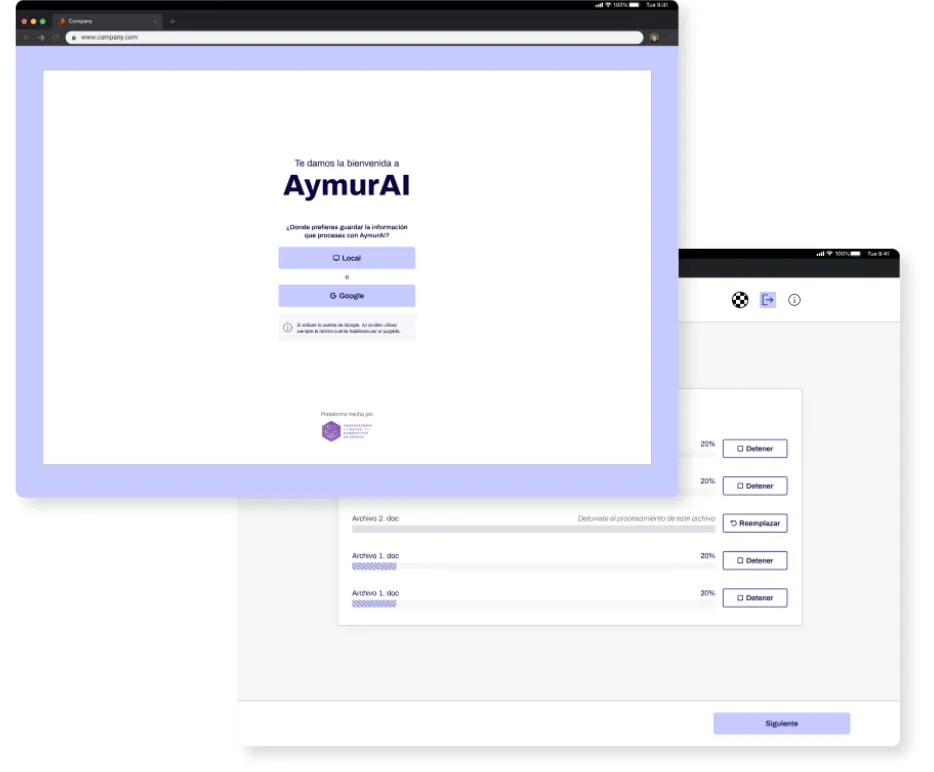
DataGénero is a feminist data organisation in Argentina that develops open-source AI tools grounded in feminist epistemologies. AymurAI was developed in 2022 in collaboration with Criminal Court 10 of Buenos Aires, academic researchers and private consulting firms, funded by philanthropists and international organisations.
AI Technology Used
Named Entity Recognition for anonymisation (detecting 30 types of sensitive information), Open-Source Desktop Architecture
Key Outcomes
Efficiency & Productivity
Accuracy & Quality Improvement
Inclusion & Equity
Knowledge & Skills Impact
AymurAI is an open-source desktop application using NLP to anonymise and structure judicial rulings on gender-based violence across Latin America. Deployed in 200+ institutions across Argentina, Chile and Costa Rica, it has created a repository of over 10,000 anonymised criminal court records. The system found that psychological and symbolic violence are the most prevalent forms (28%), physical violence appears in 20% of cases, while sexual, economic, social and environmental violence appear less frequently - making invisible patterns of GBV visible for institutional accountability and evidence-based policymaking.
Impact Metrics
Types of Gender Based Violence Documented on AymurAI
Baseline Value
NA
Post-Implementation
Psychological/symbolic violence most prevalent (28%), physical violence (20%), with sexual, economic, social and environmental violence have also been captured
Scale of AymurAI deployment across Institutions
Baseline Value
NA
Post-Implementation
Stable deployment across 200+ institutions in Argentina, Chile and Costa Rica has been recorded
Anonymised Court Records Created using AymurAI
Baseline Value
NA
Post-Implementation
Repository of over 10,000 anonymised criminal court records on gender-based violence from Latin America has been documented
Court Officials Served through AymurAI
Baseline Value
NA
Post-Implementation
Approximately 2,000 paralegal employees across three countries use the system.
Implementation Context
Deployed in more than 200 judicial institutions across Argentina, Chile and Costa Rica
2,000 paralegal employees/court officials, women, girls and LGBTIQ+ individuals affected by gender-based violence across the justice system
Key Partnerships
Criminal Court 10 of Buenos Aires (pilot partner), academic researchers, UN Women, philanthropic organisations
Replicability & Adaptation
- Frame AI as public-interest infrastructure, not standalone product
- Adapt NLP models to local languages and legal terminology
- Build long-term relationships with courts for sustained adoption
- Address judicial inertia and resistance to new data responsibilities
- Maintain consistent ethical standards across regions
Open-source architecture enables replication. Minimal infrastructure requirements - no internet access required, operates on local court servers or personal computers. Judicial documents remain on host computer, reducing security breach exposure.
* The data presented is self-reported by the respective organisations. Readers should consult the original sources for further details.