


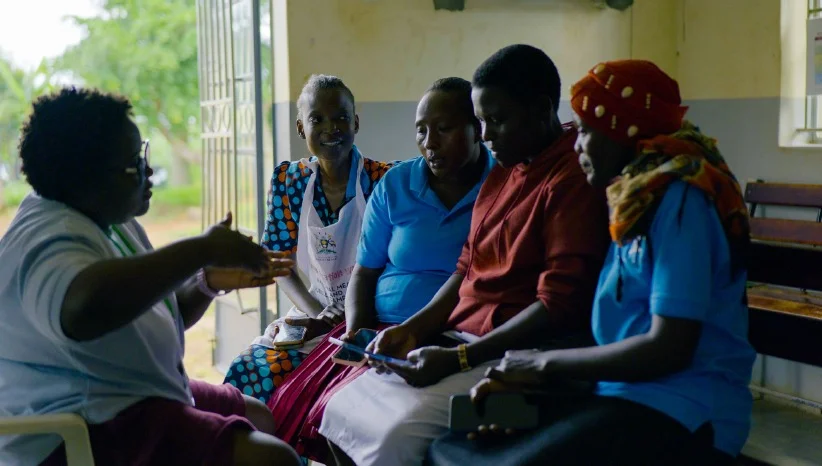
EaseHealth: Offline Clinical Decision Support for Frontline Health Workers in Luweero, Uganda

Uganda
Healthcare
Implementing Organisation
Crane AI Labs
Uganda, Central Uganda, Luweero District
Implementing Point of Contact
Kato Steven Mubiru
Co-Founder & Chief Executive Officer
Contributor of the Impact Story
Crane AI Labs
Year of implementation
2026
Problem statement
Luweero District has a population of 616,000 and a health-worker density of 7.9 per 10,000 people, against the WHO workforce-planning benchmark of 44.5 per 10,000. The District Health Officer stated that facilities "frequently lack access to current Ministry of Health guidelines." These conditions constrain access to guideline-grounded support at the point of care. Device capacity is another barrier: 97% of health workers' personal devices lacked sufficient RAM to run the model. EaseHealth makes clinical guidance accessible without connectivity during inference, using study-provided hardware, while retaining the health worker's clinical authority.
Submission Overview
Crane AI Labs builds offline-first voice and language AI for low-resource African languages, with delivery on low-cost handsets across health, agriculture and education. The organisation operates in Uganda, Kenya and Ethiopia. Offline means inference on the device without a network connection; network-delivered services are described separately. Crane is the implementing and orchestrating partner for the Voice AI Pathway under the UNDP AI Hub for Sustainable Development and the Italy-India-Kenya trilateral. It connects speech models, compute, delivery channels, enterprise partners and evaluation into a working deployment. Crane AI Labs is the first African team in Google DeepMind's Gemma partner programme. Its Gemma work supports familiar-language AI on constrained devices. Its Luganda model work uses CINECA's Leonardo supercomputer through the AI Hub. The Uganda Cultural Context Benchmark (UCCB) is included in the UK AI Security Institute-linked Inspect Evals repository.
AI Technology Used
Key Outcomes
Access & Reach
Resilience & Risk Reduction
In Luweero District, health worker density is 7.9 per 10,000 people against a WHO planning benchmark of 44.5, and facilities often lack current clinical guidelines. EaseHealth puts guideline-grounded decision support directly into the hands of frontline health workers, running entirely on the device with no connectivity needed. Since most workers’ personal phones couldn’t run the model, the programme provided suitable Android devices and today, over 200 health workers across 15 facilities in four sub-counties and town councils have been trained and enrolled. The tool supports decisions rather than replacing them, and the health worker remains in charge of care. EaseHealth shows how AI can reach the last mile of the health system, where connectivity and expertise are scarcest.
Impact Metrics
Enrolled reach
Baseline Value
Not measured Health workers
Post-Implementation
Over 200 frontline health workers consented and enrolled Health workers
Facility coverage
Baseline Value
Not measured Facilities
Post-Implementation
15 health facilities
Area coverage
Baseline Value
Not measured Areas
Post-Implementation
Four sub-counties and town councils Areas
Implementation Context
Luweero District, Central Uganda, approximately 75 km north of Kampala
Frontline health workers serving rural and underserved communities. Over 200 consented and enrolled across 15 health facilities in four sub-counties and town councils; over 200 attended the district workshop (attendance and enrolment are different measures and are not added). The district population of 616,000 is context, not a count of beneficiaries reached. Patient reach and participant demographic breakdowns were not measured.
Key Partnerships
Luweero district leadership (Government) — District Health Officer selected facilities, assigned a coordinator and provided the venue; demand-pull implementation through district leadership. Makerere University (Academia) — academic and clinical partnership; Clinical Co-Principal Investigator: Prof. Josaphat Byamugisha. Google.org Health AI (Philanthropic organisation) — philanthropic support. Crane AI Labs (Private sector) — EaseHealth development, technical deployment and implementation support. Regulatory oversight (distinct from partnership): Makerere University School of Health Sciences REC approval MAKSHSREC-2026-41 (17 April 2026); Uganda National Council for Science and Technology clearance HS7408ES (20 April 2026); scope: feasibility and acceptability of offline clinical decision support for frontline health workers in Uganda; valid until 31 March 2027.
Replicability & Adaptation
- Establish local leadership: agree health-worker workflows, district coordination, clinical supervision and referral access; assess local devices, power and maintenance before budgeting.
- Review guidance for the receiving context: Uganda Clinical Guidelines do not transfer unchanged; local clinical partners must supply and review applicable guidance, terminology and languages.
- Obtain local authorisations: local relationships and ethics/national approvals must be established afresh.
- Evaluate with intended users: assess feasibility, acceptability and safety locally; test operation without connectivity, device compatibility, support arrangements and maintenance.
The documented single-district deployment does not establish minimal-adaptation performance across multiple contexts. The capability to work offline is transferable; the same clinical guidance, relationships, device affordability and conditions of use cannot be assumed elsewhere. Existing REC and UNCST approvals do not authorise deployment in another jurisdiction or outside the approved study scope.
* The data presented is self-reported by the respective organisations. Readers should consult the original sources for further details.