


AutoScriber: AI-Powered Clinical Intelligence for Automated Medical Documentation, Structured Data Extraction, and Seamless EHR Workflow Integration

Netherlands
Healthcare
Implementing Organisation
Autoscriber
Netherlands, Noord-Brabant, Eindhoven
Implementing Point of Contact
Danny Van Rijn
Chief Operating Officer
Contributor of the Impact Story
Government of Netherlands
Year of implementation
2023
Problem statement
Healthcare professionals are currently facing an administrative crisis, spending a disproportionate amount of their workday - often hours after shifts - on manual clinical documentation. This "pajama time" leads to severe clinician burnout, decreased job satisfaction, and a fragmented patient-doctor relationship, as practitioners are forced to focus on screens rather than eye contact. Furthermore, manual data entry is prone to human error and often results in unstructured notes that are difficult to analyse. The challenge lies in capturing complex medical dialogues and converting them into high-quality, structured clinical data, codes, and follow-up orders within Electronic Health Records (EHR) without interrupting the natural flow of a consultation. There is a critical need for a solution that automates these administrative tasks while ensuring data accuracy and interoperability.
Submission Overview
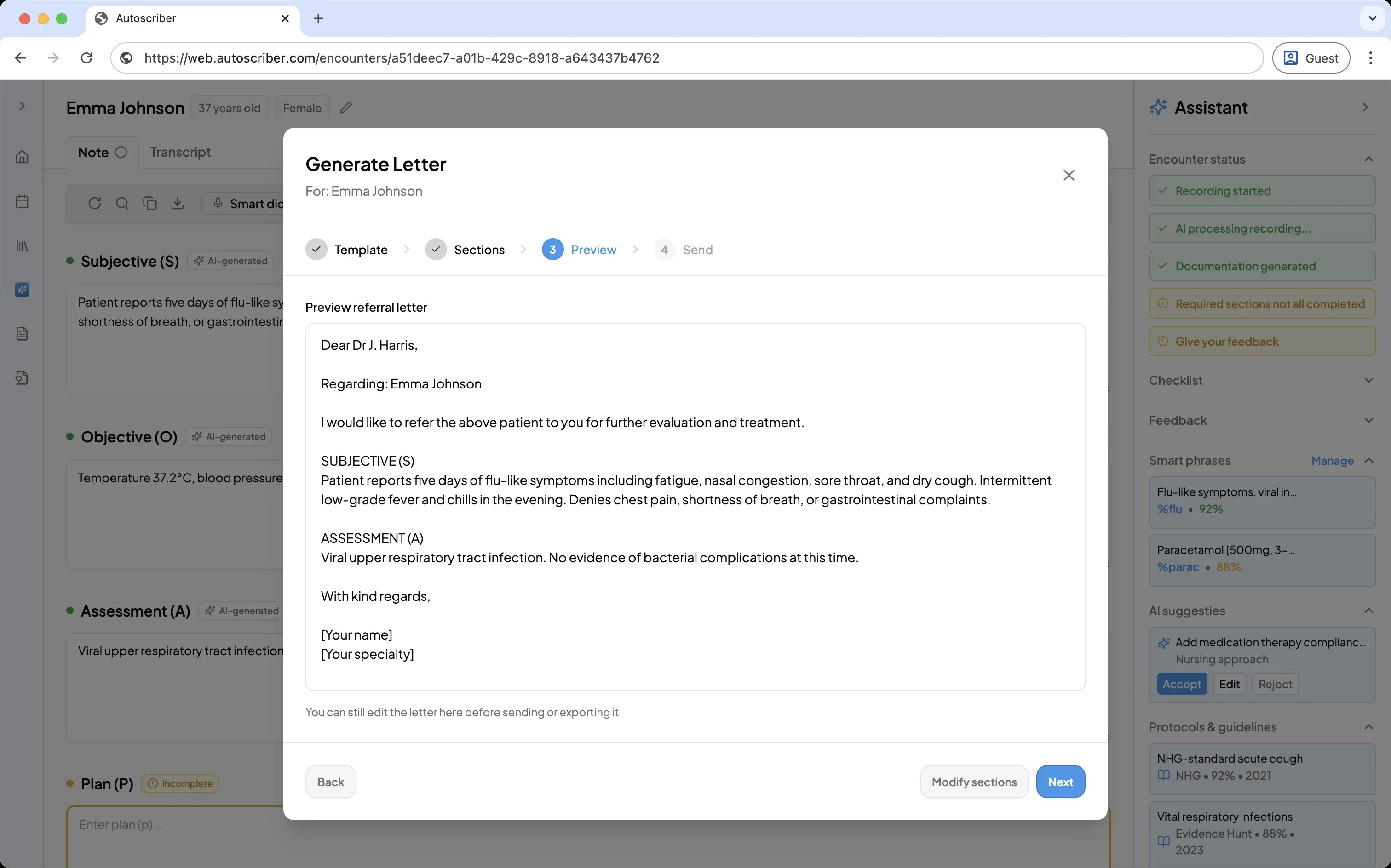
Autoscriber has built a cutting-edge health-tech solution designed to alleviate the administrative burden on healthcare professionals by leveraging advanced AI-powered speech recognition and Natural Language Processing. The Autoscriber platform captures the dialogue between a doctor and a patient in real-time, intelligently transforming the conversation into high-quality clinical documentation. Moving beyond simple transcription, Autoscriber focuses on deep clinical understanding to automatically populate Electronic Health Records (EHR) with high precision. It extracts not only narrative text but also discrete, structured data points and medical codes, ensuring that the information is immediately actionable. By identifying specific clinical values and intent, the system can prepopulate follow-up actions such as diagnostic orders, prescriptions, and billing codes directly within the EPD/EHR workflow. This seamless integration allows clinicians to remain fully present with their patients, maintaining eye contact and engagement without the distraction of manual data entry. By turning spoken consultations into structured medical data and automated ordering tasks, Autoscriber significantly reduces the time spent on paperwork, minimises the risk of human error, and helps combat clinician burnout while improving the overall quality of patient care.
AI Technology Used
Key Outcomes
Efficiency & Productivity
Accuracy & Quality Improvement
User Experience & Satisfaction
Economic Value Creation
Autoscriber uses AI-powered speech recognition to automate medical documentation and reduce the administrative burden on healthcare professionals. It captures clinical dialogues and converts them into structured notes integrated directly into electronic health records. Clinicians save an average of five minutes per consultation. Administrative burden has dropped meaningfully for the majority of users. Most report improved patient interaction and immediate gains in job satisfaction, and nearly all recommend the tool. The platform reduces the overall time spent on documentation and increases time for direct patient care.
Impact Metrics
Time saved per consultation using AutoScriber
Baseline Value
NA Minutes
Post-Implementation
Average saving of 5 minutes per consultation Minutes
Users recommendation expectancy using AutoScriber
Baseline Value
NA Percentage
Post-Implementation
95 % of end users recommend using AutoScriber
Improvement in Patient Interaction using AutoScriber
Baseline Value
NA Percentage
Post-Implementation
70 % of users experienced improved patient interaction using AutoScriber
Improvement in Job Satisfaction using AutoScriber
Baseline Value
NA Percentage
Post-Implementation
65 % of users experienced an immediate improvement using AutoScriber
Reduction in Administrative burden due to Autoscriber usage
Baseline Value
NA Percentage
Post-Implementation
70 % of end users saw an immediate reduction in administrative burden due to Autoscriber usage
Implementation Context
European Union
Healthcare professionals
Key Partnerships
Microsoft, Google
Replicability & Adaptation
- Technical implementation in Electronic Health Records (EHRs)
- Local language and clinical note adaptation
Supporting Materials

* The data presented is self-reported by the respective organisations. Readers should consult the original sources for further details.