


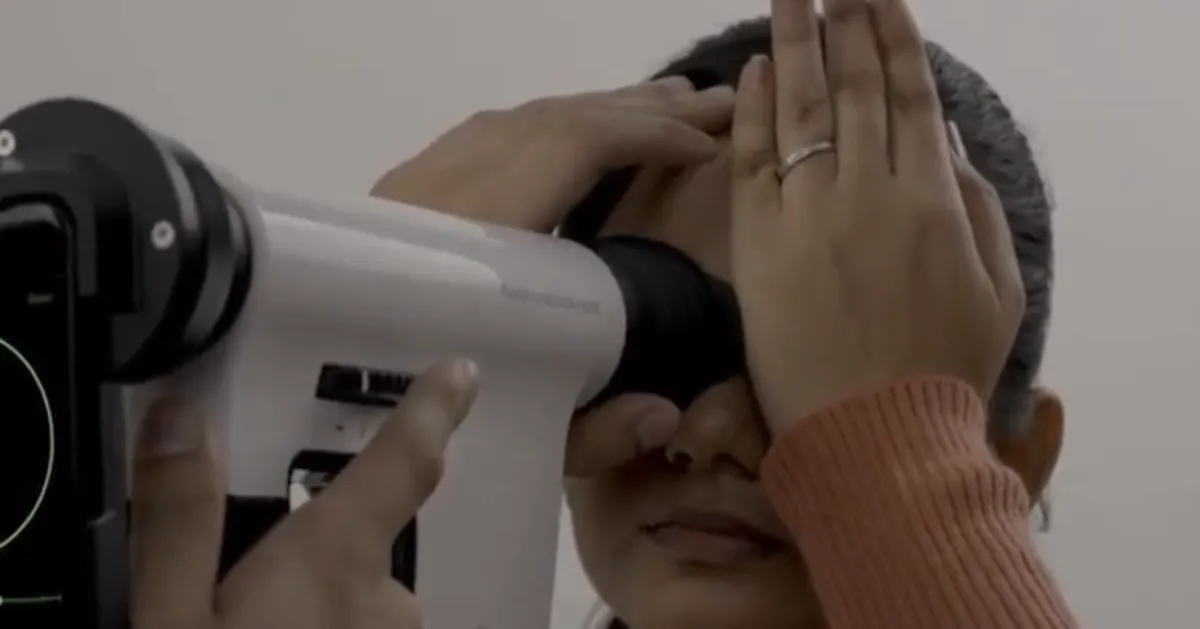
Nayanamritham 2.0: AI-Assisted Chronic Eye Disease Screening Initiative

India
Healthcare
Implementing Organisation
Remidio Innovative Solutions Pvt Ltd
India, Kerala, Pan-State
Implementing Point of Contact
Anusha Purushotham
Head, Health Systems and Policy
Contributor of the Impact Story
World Health Organization (WHO)
Year of implementation
2019
Problem statement
India bears a disproportionate share of the global burden of visual impairment, with an estimated 8 million blind individuals and over 60 million people with moderate to severe visual impairment, much of which is preventable through early detection and timely care. Chronic eye diseases - particularly diabetic retinopathy, glaucoma, and age-related macular degeneration - are increasingly responsible for this burden as India undergoes rapid epidemiological and demographic transition. Kerala faces an especially acute risk, with adult diabetes prevalence at 15–20% among the highest in India, yet over 90% of individuals with diabetic retinopathy are unaware of their condition at diagnosis, reflecting silent disease progression in the absence of routine screening. Glaucoma and age-related macular degeneration add to this burden, with late presentation leading to irreversible vision loss and avoidable health-system costs. India's public health system faces structural constraints in delivering systematic eye screening: retinal examination remains concentrated in secondary and tertiary facilities and heavily dependent on ophthalmologists who are unevenly distributed and insufficient relative to population need, while primary care facilities typically lack retinal imaging capacity and conventional outreach models like eye camps provide only episodic access poorly suited to chronic disease management and follow-up.
Submission Overview
Remidio Innovative Solutions Pvt Ltd is a Bengaluru-based health technology innovator that developed the MediosHI 3-in-1 Edge AI, a software as a medical device that analyses retinal images to screen for diabetic retinopathy, glaucoma, and age-related macular degeneration. The system uses convolutional neural networks trained on over 200,000 retinal images from diverse populations, including data from established datasets such as AREDS and EyePACS, with each image graded by expert ophthalmologists. The solution's offline, on-device architecture enables immediate screening outputs at the point of care without internet connectivity, ensuring consistent performance in real-world conditions. Remidio's technology has been validated through independent clinical evaluations including the NHS landmark study published in The Lancet Digital Health, and is approved by both India's CDSCO and CE-marked in the European Union. Through partnership with the Government of Kerala, Remidio has demonstrated how public-private collaboration can create context-appropriate, scalable solutions that address real operational constraints in public health systems.
AI Technology Used
Convolutional Neural Networks (CNNs)
Key Outcomes
Access & Reach
Inclusion & Equity
Accuracy & Quality Improvement
Resource Efficiency
Resilience & Risk Reduction
Nayanamritham 2.0 powered by Remidio's technology scaled from 16 facilities to over 250 public health institutions statewide, shifting from episodic camps to continuous, facility-based screening. Detection rates improved from 17% to 22% for diabetic retinopathy, with most cases representing previously undiagnosed disease. More than 100 optometrists were trained, reporting increased diagnostic confidence and clearer clinical roles, while ophthalmologists experienced reduced routine screening burden and improved clinic flow. AI-enabled triaging reduced inappropriate referrals and allowed specialists to prioritise high-risk patients. The pilot phase demonstrated strong cost-effectiveness at INR 22,000 per QALY, generating 514 QALYs from 5,307 screened individuals - well below WHO thresholds. Patients reported better understanding of disease risk through visual reports, improving follow-up adherence. The programme proved that AI can amplify health system capacity without additional specialist staffing, strengthening rather than displacing human expertise.
Impact Metrics
Number of public health facilities equipped with Remidio's AI-enabled fundus cameras for chronic eye disease screening across Kerala's health system under Nayanamritham 2.0
Baseline Value
Previously, 16 facilities in the Thiruvananthapuram district were equipped as part of a pilot phase in 2019 Number of facilities
Post-Implementation
Over 250 statewide public health institutions, including primary health centers, community health centers, and district hospitals, have been equipped with AI-enabled fundus cameras, with 30 centers actively using AI for screening Number of facilities
The percentage of screened individuals with diabetes who were found to have diabetic retinopathy, comparing detection rates before and after Nayanamritham 2.0's AI integration via Remidio
Baseline Value
Previously, during the pilot phase with manual image grading and tele-ophthalmology, diabetic retinopathy was detected in approximately 17% of screened individuals Percentage
Post-Implementation
After Nayanamritham 2.0's AI deployment, detection rates increased to around 22%, reflecting improved image quality and more consistent identification of referable disease Percentage
The number of optometrists trained to deliver Nayanamritham 2.0's AI-assisted screening for three chronic eye diseases in Kerala's public health system
Baseline Value
Previously, only a limited number of optometrists were trained during the pilot phase, and they relied on manual grading or tele-ophthalmology without AI support Number of trained personnel
Post-Implementation
More than 100 optometrists across Kerala have now completed structured training to deliver AI-assisted screening using Nayanamritham 2.0 Number of trained personnel
The shift in Kerala's eye screening approach from episodic outreach camps to continuous, facility-based screening integrated within routine primary and secondary care through Nayanamritham 2.0
Baseline Value
Previously, eye screening in Kerala relied primarily on episodic outreach eye camps that provided one-time access but were poorly suited to chronic disease management and follow-up Screening model type
Post-Implementation
Nayanamritham 2.0 has established continuous, facility-based screening embedded in routine NCD clinics and Family Health Centers across Kerala's public health system Screening model type
The number of chronic eye diseases that can be screened simultaneously through Nayanamritham after Remidio's MediosHI 3-in-1 AI integration
Baseline Value
Before Remidio's integration, Nayanamritham 1.0 pilot screened only for diabetic retinopathy Number of diseases screened
Post-Implementation
After Remidio's integration, Nayanamritham 2.0 screens simultaneously for three chronic eye diseases: diabetic retinopathy, glaucoma, and age-related macular degeneration Number of diseases screened
Implementation Context
Kerala, India
Current usage is in 250 statewide public health institutions. Users include optometrists, ophthalmologists, district and state programme managers, particularly in rural and underserved communities facing barriers to specialist eye care.
Key Partnerships
Department of Health Services, Government of Kerala, district hospitals, community health centres, and primary health centres
Replicability & Adaptation
Supporting Materials

* The data presented is self-reported by the respective organisations. Readers should consult the original sources for further details.