


FarmAdvice: Closing the 1:50,000 Extension Gap via Voice-First AI

Nigeria
Agriculture
Implementing Organisation
Crop2Cash Ltd.
Nigeria, Pan-Country
Implementing Point of Contact
Olorunniisola Alagbe
Technology Lead
Contributor of the Impact Story
Government of Maharashtra’s AI and Agritech Innovation Center, World Bank Group, Wadhwani AI
Year of implementation
2024
Problem statement
In Sub-Saharan Africa, the agricultural extension gap is a critical barrier to food security, with farmer-to-officer ratios reaching an unsustainable 1:50,000 in many regions. Traditional digital advisory tools often encounter a 'literacy wall,' requiring smartphones and data access that remain scarce in rural communities. This disparity leaves millions of smallholder farmers without the guidance needed to adapt to erratic weather or manage pest outbreaks. Despite high mobile phone penetration (93% in Nigeria), smallholders struggle to access reliable agricultural information due to literacy barriers and high data costs. The lack of scalable, accessible extension services undermines climate resilience, productivity, and income stability for Africa's most vulnerable farming communities, directly impacting food security and rural livelihoods.
Submission Overview
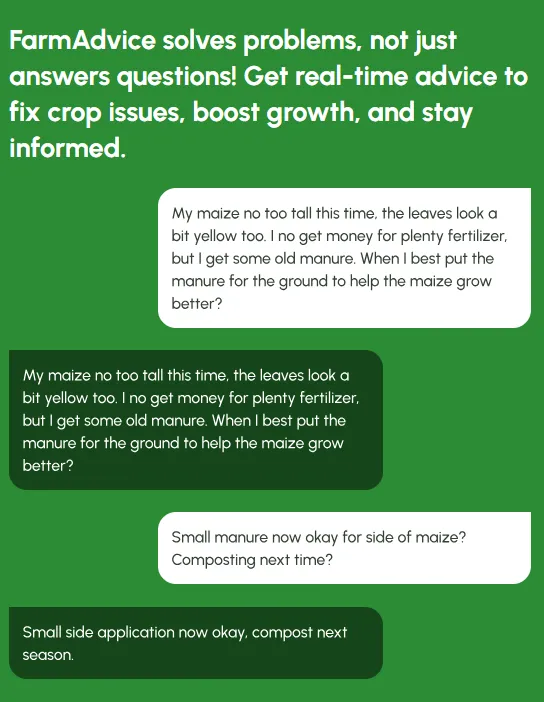
Crop2Cash is a Nigerian agri-tech company revolutionising agricultural extension services through artificial intelligence. Operating in Sub-Saharan Africa where extension-officer-to-farmer ratios reach an unsustainable 1:50,000, Crop2Cash addresses the critical gap in agricultural advisory services that traditional systems cannot bridge. The company's flagship product, FarmAdvice (the National Hotline for Agriculture), deploys a generative AI-powered digital extension agent accessible via basic mobile phones, eliminating barriers of literacy, smartphone ownership, and data costs that plague conventional digital solutions. Through an AI-driven Interactive Voice Response (IVR) system, FarmAdvice provides real-time, expert-vetted agronomic advice in native dialects with 88-95% transcription accuracy. The solution grounds its AI engine in verified datasets from the International Institute of Tropical Agriculture (IITA) and Nigeria's Ministry of Agriculture, maintaining 99% grounding fidelity and eliminating AI hallucinations. In its first 12 months post-pilot, FarmAdvice reached 26,000 smallholder farmers, demonstrating the scalability of voice-first AI in bridging the digital divide and strengthening climate resilience for Africa's most vulnerable agricultural communities.
AI Technology Used
Natural Language Processing
Key Outcomes
Access & Reach
Inclusion & Equity
Efficiency & Productivity
Economic Value Creation
Resilience & Risk Reduction
User Experience & Satisfaction
Crop2Cash's FarmAdvice is transforming agricultural resilience across Sub-Saharan Africa by deploying voice-first AI to close the critical 1:50,000 extension-officer-to-farmer gap. Accessible via any basic mobile phone, the platform has reached 26,000 smallholder farmers in 12 months, delivering expert-vetted agronomic advice in local dialects with 96.8% contextual relevance and 99% grounding fidelity. By achieving a breakthrough improvement in speech recognition accuracy (from 35% to 88-95% for African accents) and eliminating barriers of literacy, smartphones, and data costs, FarmAdvice enables farmers to increase incomes by 70% while ensuring 30% representation of women and youth. The platform demonstrates that AI, when grounded in verified datasets and delivered through inclusive channels, can democratise agricultural knowledge, strengthen climate adaptation, and unlock economic opportunity for Africa's most vulnerable farming communities.
Impact Metrics
Increase in farmer income for users of the broader Crop2Cash suite (including FarmAdvice)
Baseline Value
Standard income without AI-driven advisory support Percentage
Post-Implementation
70 % increase in farmer income
Total number of smallholder farmers accessing FarmAdvice advisory services
Baseline Value
Limited access to personalised agricultural advisory (1:50,000 extension ratio) Number of farmers
Post-Implementation
26 ,000+ farmers reached within 12 months post-pilot
Contextual relevance score and grounding fidelity of FarmAdvice's AI-generated agricultural advice
Baseline Value
Generic agricultural advice without local context or verified grounding Percentage
Post-Implementation
96.8 % contextual relevance score; 99% grounding fidelity (zero hallucinations)
Accuracy of accented speech transcription in local dialects
Baseline Value
35 % transcription accuracy was recorded during initial deployment
Post-Implementation
88 -95% transcription accuracy was recorded after 12 months of optimisation
Percentage of women and youth accessing FarmAdvice services
Baseline Value
Limited representation of women and youth in traditional extension services Percentage
Post-Implementation
30 % minimum inclusion quota enforced for women and youth in participating cooperatives
Implementation Context
Current deployment in Nigeria with planned regional expansion in Kenya underway
More than 26,000 rural smallholder farmers (with 30% inclusion quota for women and youth), agro-processors, development finance institutions (DFIs), and NGOs
Key Partnerships
International Institute of Tropical Agriculture (IITA) and the Nigerian Ministry of Agriculture
Replicability & Adaptation
- The FarmAdvice solution requires context-specific adaptation for successful replication in new regions. Key modifications include localisation of speech recognition models to support regional dialects and accents, which may require 6-12 months of iterative training.
- Agricultural knowledge bases must be customised to reflect local crop varieties, pest pressures, soil types, and climate conditions through partnerships with regional agricultural institutions.
- The 'Phygital' adoption strategy should be adapted to local farmer cooperative structures and existing agricultural value chains.
- Telecommunications infrastructure partnerships are critical and must be negotiated based on regional carrier capabilities and coverage
- Inclusion quotas should be adjusted to reflect local gender dynamics and youth participation rates in agriculture.
- The solution's success depends on strong partnerships with government agricultural agencies, research institutions, and farmer organisations to ensure content credibility and trust.
* The data presented is self-reported by the respective organisations. Readers should consult the original sources for further details.