


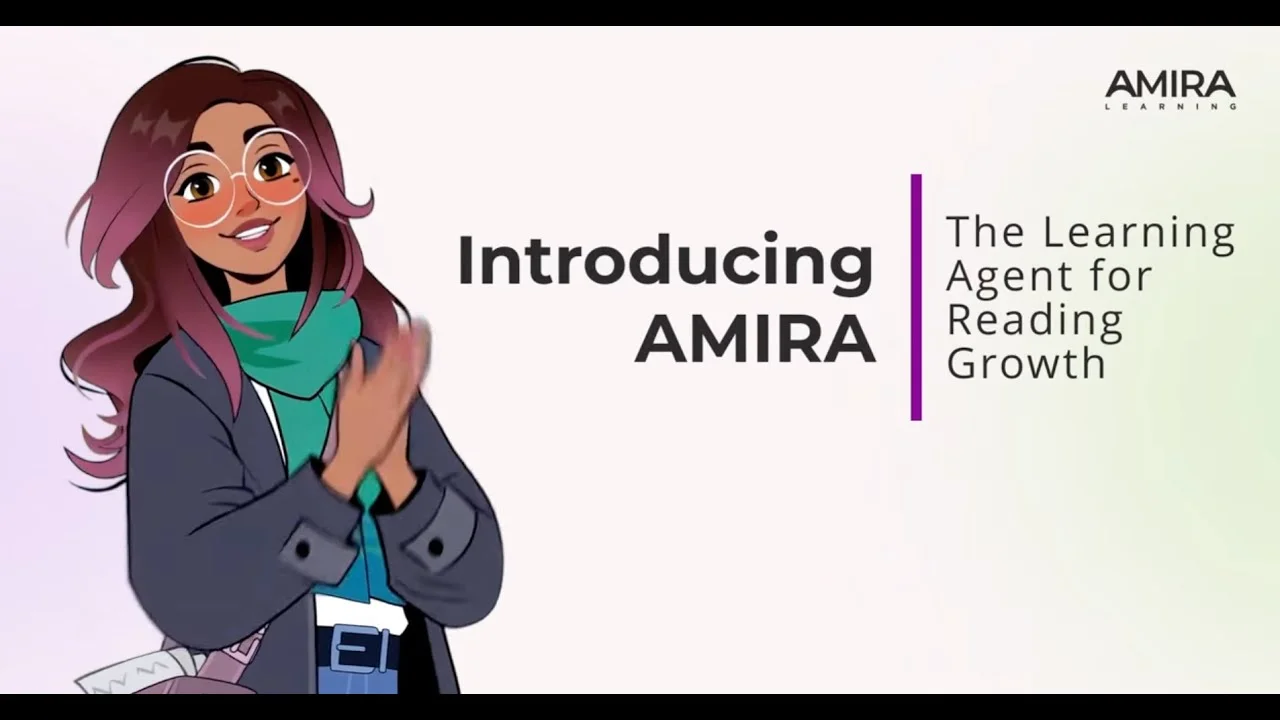
Amira Learning: An AI-Powered Oral Reading Tutor for Low-Resource Education Settings

India
Education
Implementing Organisation
Amira Learning
India, Delhi
Amira Learning is headquartered in Washington, United States, but has carried out global deployment including in India and Sub-Saharan Africa and South Africa.
Implementing Point of Contact
Adam Porsch
Head of Grants and Partnerships
Contributor of the Impact Story
Central Square Foundation (CSF)
Year of implementation
2020
Problem statement
Foundational literacy remains a global challenge, particularly in low-resource systems where large class sizes, limited teacher capacity, and infrastructure constraints prevent consistent individualised reading practice. Research shows that frequent oral reading with immediate corrective feedback is critical for literacy development, yet delivering this level of personalised support at scale is operationally difficult. In Delhi municipal schools, limited instructional time and constrained teacher capacity created a need for scalable, individualised literacy intervention integrated into the regular school day.
Submission Overview
Amira Learning is an education technology company grounded in over 30 years of research at Carnegie Mellon University on intelligent tutoring systems for literacy. Originating from Project LISTEN, Amira was developed to operationalise evidence-based oral reading practice at scale using artificial intelligence. The organisation specialises in AI-driven literacy tutoring aligned with the Science of Reading, combining speech recognition, natural language processing, and learning analytics to deliver personalised reading support. Amira is currently deployed across all 50 U.S. states and 18 countries, supporting approximately 4 million students. Its model emphasises measurable learning growth, teacher-facing data dashboards, and scalable implementation within existing instructional blocks.
AI Technology Used
Speech Recognition, Automatic Speech Recognition (ASR), Error detection models, Learning analytics
Key Outcomes
Access & Reach
Amira Learning delivers AI-powered, Science of Reading - aligned oral reading tutoring to accelerate foundational literacy in low-resource education settings. In partnership with the Khushii NGO, Amira was deployed across four municipal schools in Delhi, where 135 students engaged in short, structured weekly reading sessions integrated into the school day. By listening to students read aloud, detecting decoding errors in real time, and delivering immediate corrective prompts, the AI tutor provided individualised instruction that would otherwise be infeasible in large classrooms. Over five months, students’ Amira Reading Measure (ARM) scores increased from 1.79 to 2.78 - equivalent to approximately ten months of learning growth despite attendance variability and a 1.5-month summer break. Globally, Amira supports over 4 million students across 50 U.S. states and 18 countries, with effect sizes (~0.45) comparable to high-quality one-on-one human tutoring. This case demonstrates that AI-enabled tutoring, delivered with consistent dosage, can provide scalable, equitable literacy gains across diverse and resource-constrained environments.
Impact Metrics
Student literacy growth measured using the Amira Reading Measure (ARM)
Baseline Value
Average ARM score of 1.79 across participating students ARM score (standardised literacy growth measure)
Post-Implementation
Average ARM score increased to 2.78 over five months of implementation, representing approximately 10 months of learning growth despite attendance variability and a 1.5-month summer break ARM score (standardised literacy growth measure)
Effect size of AI-supported reading intervention compared to standard classroom instruction
Baseline Value
Students receiving standard classroom literacy instruction without AI tutoring Effect size (Cohen’s d)
Post-Implementation
Effect sizes of approximately 0.45 for students using Amira at recommended dosage, comparable to high-quality one-on-one human tutoring Effect size (Cohen’s d)
Learning acceleration relative to instructional time due to use of the AI tutor
Baseline Value
Typical literacy progression aligns approximately with one month of learning growth per month of instruction Learning acceleration ratio (months of growth per month of instruction)
Post-Implementation
Students achieved approximately 10 months of literacy growth within a five-month instructional period, representing approximately 2x expected learning velocity Learning acceleration ratio (months of growth per month of instruction)
Instructional dosage required to achieve accelerated literacy gains
Baseline Value
Large classroom environments with limited capacity for individualised oral reading practice Minutes of AI-supported instruction per week
Post-Implementation
Accelerated literacy growth achieved with approximately 30 minutes of AI-supported oral reading practice per week, delivered in three 10–12 minute sessions Minutes of AI-supported instruction per week
Implementation Context
The AI tutor has been implemented across 4 municipal schools in Delhi and 4 million students across 50 US states and 18 countries.
Early-grade students (K–5; foundational literacy stage), teachers, instructional coaches, and NGO facilitators
Key Partnerships
Khushii NGO (Delhi implementation partner), municipal schools in Delhi, Carnegie Mellon University, state education agencies in the United States
Replicability & Adaptation
- Student-accessible devices with microphones
- Internet connectivity
- Teacher onboarding and training
- Implementation fidelity monitoring
- Subscription licensing and cloud infrastructure
This is because:
- Requires only short (10–12 minute) structured sessions
- Integrates into existing literacy instruction
- No need for additional staffing
- Adaptable across languages and accents
- Evidence of transferability across U.S., Africa, and India
- Replication requires device access and stable audio input but does not require advanced infrastructure
* The data presented is self-reported by the respective organisations. Readers should consult the original sources for further details.