


Rocket Learning: Scaling AI-Powered Personalised Learning for 4 Million Children in Rural India

India
Education
Implementing Organisation
Rocket Learning
India, Karnataka and 10 other Indian States, Pan-State
Implementing Point of Contact
Kshitij Jain
Senior Product Manager
Contributor of the Impact Story
Central Square Foundation (CSF)
Year of implementation
2025
Problem statement
In India’s early childhood education ecosystem, millions of children aged 3–6 receive worksheets through home-based learning models but lack immediate, structured feedback on their work. While Rocket Learning successfully distributed worksheets to 4 million children via WhatsApp, the absence of scalable assessment mechanisms created a persistent “feedback gap.” Manual correction was infeasible due to limited capacity among 300,000 Anganwadi workers, leading to delayed or absent feedback, reduced learning reinforcement, and lower engagement.
Submission Overview
Rocket Learning is an education-focused organisation working to strengthen early childhood development outcomes across India by partnering with government Anganwadi systems. The organisation delivers structured, curriculum-aligned learning content to families through widely accessible platforms such as WhatsApp, enabling large-scale home-based learning for children aged 3–6. With a strong operational footprint across 11 states and 180 districts, Rocket Learning combines behavioural science, government partnerships, and technology innovation to improve foundational literacy and numeracy. Its approach emphasises scalable, low-cost digital solutions that function in low-resource settings, ensuring equitable access to high-quality early learning support for millions of children.
AI Technology Used
Computer Vision, Optical Character Recognition (OCR), Neural networks for mark detection
Key Outcomes
Access & Reach
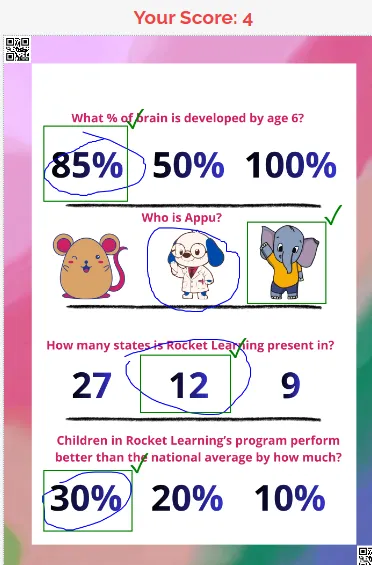
Rocket Learning has embedded AI-powered Computer Vision into its existing WhatsApp-based early learning platform to close the “feedback gap” for 4 million children aged 3–6 across rural India. By transforming a standard smartphone into an automated worksheet assessor, the system provides instant, annotated feedback within seconds—turning passive worksheet distribution into an interactive learning loop. Deployed across 11 states and 180 districts, the solution reduces the manual correction burden on 300,000 Anganwadi workers while increasing engagement, driving a 4% rise in daily active users and a 5% increase in average user interactions. Designed for low-end devices and low-bandwidth settings, the intervention demonstrates how lightweight AI infrastructure can scale personalised feedback nationally, improving early learner confidence and strengthening foundational literacy and numeracy outcomes in low-resource environments.
Impact Metrics
Children reached through AI-powered worksheet auto-correction system
Baseline Value
No AI-enabled automated feedback system integrated into worksheet submissions Number of children reached
Post-Implementation
4 million children served across 180 districts in 11 states
Increase in daily active user engagement
Baseline Value
Pre-AI deployment engagement levels Percentage increase
Post-Implementation
4 % increase in daily active users following AI feedback integration
Increase in average messages per user (interaction intensity)
Baseline Value
Pre-AI deployment messaging activity levels Percentage increase
Post-Implementation
5 % increase in average messages per user after introduction of instant AI feedback
Implementation Context
11 States and 180 districts across India
4 million children aged 3–6 (Pre-K), 300,000 Anganwadi workers, and parents
Key Partnerships
Anganwadi Workers, parents, and State-level Early Childhood Education systems
Replicability & Adaptation
- No hardware requirements beyond basic smartphones
- Works on low-end devices and low bandwidth
- Multilingual support (Hindi, English, Marathi, Punjabi)
- Modular AOI-based correction adaptable to new worksheets
- Deployable in other low-resource education systems using messaging platforms
* The data presented is self-reported by the respective organisations. Readers should consult the original sources for further details.