


Dimagi's Gen AI Assistant: Reducing Friction in NTD Data Repositories

Ireland
Healthcare
Implementing Organisation
Dimagi
Ireland, Pan-Regional
Headquartered in Ireland, but global deployment across 48 endemic countries in the WHO African region
Implementing Point of Contact
Namrata Tomar
Research and Operations Manager, Dimagi
Contributor of the Impact Story
World Health Organization (WHO)
Year of implementation
2024
Problem statement
The WHO AFRO ESPEN Portal serves as the central knowledge and data platform for 48 NTD-endemic countries in the African region, hosting over 11.6 million rows of subnational datasets, 15,000+ geospatial maps, and extensive WHO technical guidelines. Despite this rich repository, users faced significant difficulty navigating static PDFs and complex datasets, leading to underutilisation of available information and a high manual support burden on ESPEN staff. Baseline testing showed that answering routine programmatic queries could require up to 15 minutes of manual navigation. This “data-rich but information-poor” paradox limited timely decision-making by national NTD programme managers, who require rapid access to subnational prevalence data, operational guidance, and campaign intelligence. There was a need for an intelligent, safe, and multilingual interface that could unlock existing data infrastructure, reduce friction in accessing technical knowledge, and strengthen country-level decision-support without compromising governance safeguards.
Submission Overview
Dimagi is a global digital health and data systems organisation that designs and deploys scalable technology solutions to strengthen public health systems in low- and middle-income countries. Founded in 2002, Dimagi is best known for CommCare, one of the most widely used open-source digital platforms supporting frontline health workers across more than 80 countries. Its tools enable governments and implementing partners to digitise service delivery workflows, improve data visibility, and enhance programme monitoring across domains including maternal and child health, infectious diseases, supply chains, and community health systems.
AI Technology Used
Generative AI, Retrieval-Augmented Generation (RAG), Multilingual Large Language Models
Key Outcomes
Resource Efficiency
Efficiency & Productivity
User Experience & Satisfaction
Resilience & Risk Reduction
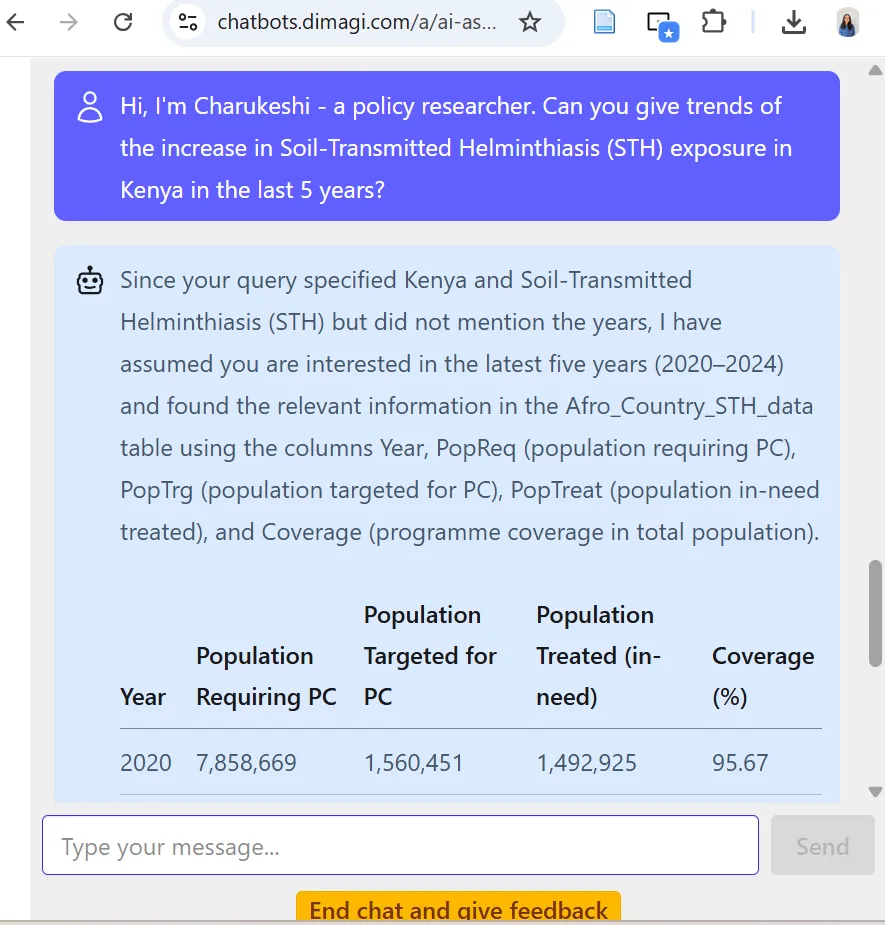
Dimagi, in partnership with WHO AFRO/ESPEN and the Gates Foundation, has developed and deployed a Generative AI assistant that transforms the ESPEN Portal from a static data repository into an interactive, multilingual decision-support system serving Neglected Tropical Disease (NTD) programmes across 48 African countries. Using a Retrieval-Augmented Generation (RAG) architecture, Dimagi built a tool that enables national programme managers to query complex geospatial datasets, national reports, and elimination guidelines in natural language and receive source-cited responses in English, French, and Portuguese. The assistant reduces time spent searching for technical resources, lowers the operational burden on central ESPEN staff, and enables country teams to independently access and interpret critical programme data. Early deployment indicates improved workflow efficiency and greater user confidence in navigating technical guidance. Designed with safety guardrails and embedded within existing public health processes, the solution complements human expertise rather than replacing it. This initiative demonstrates Dimagi’s capacity to integrate responsible GenAI into large-scale public health infrastructure, strengthening knowledge access, reducing operational bottlenecks, and supporting progress toward NTD elimination across resource-constrained settings.
Impact Metrics
Reduction in time to answer knowledge-related queries
Baseline Value
Up to 15 minutes required for manual navigation to answer routine programmatic queries Relative time reduction
Post-Implementation
Knowledge-related queries answered approximately 17× faster using the AI assistant Relative time reduction
Reduction in time to retrieve quantitative data using the AI-assistant
Baseline Value
Manual extraction and navigation of portal datasets Relative time reduction
Post-Implementation
Data-related queries answered approximately 2× faster than traditional navigation methods Relative time reduction
User engagement depth per session
Baseline Value
No AI-enabled interactive engagement layer within the portal Minutes per session
Post-Implementation
Average of 12.9 minutes per session, indicating sustained technical engagement Minutes per session
Geographic deployment coverage across NTD-endemic countries
Baseline Value
No AI-enabled decision-support tool embedded within the ESPEN Portal across member countries Number of countries
Post-Implementation
AI assistant deployed and accessible via the ESPEN Portal across all 48 NTD-endemic countries in the WHO African Region Number of countries
Implementation Context
48 Neglected Tropical Diseases (NTD)-endemic countries in the WHO African Region
National NTD programme managers, Ministry of Health technical staff, regional WHO AFRO/ESPEN teams, public health implementers and partners
Key Partnerships
WHO Expanded Special Project for Elimination of Neglected Tropical Diseases (ESPEN), Gates Foundation
Replicability & Adaptation
- Curated and machine-readable knowledge base
- RAG pipeline architecture
- LLM access (model-agnostic)
- SQL agents for structured data querying
- ETL analytics pipeline for monitoring
- AI engineers
- Data engineers for cleaning legacy PDFs
- Subject matter experts for source validation
- Governance/advisory oversight body
- Cloud hosting and inference costs (demonstrated low marginal cost: ~$0.02 per query)
- Ongoing model tuning and safety testing
The model is highly replicable in other public health and government knowledge platforms that suffer from similar data friction challenges.
Supporting Materials

* The data presented is self-reported by the respective organisations. Readers should consult the original sources for further details.