


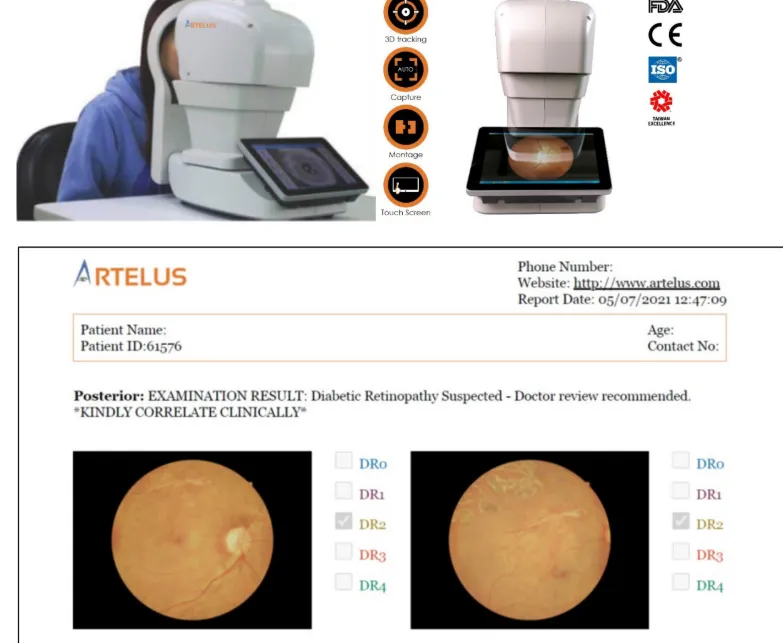
Artelus: AI-Powered Retinal Abnormality Screening Tool

India
Healthcare
Implementing Organisation
Artificial Learning Systems India Pvt Ltd (Artelus)
India, Karnataka, Bengaluru
Implementing Point of Contact
Girish Somvanshi
Director
Contributor of the Impact Story
Carnegie India
Year of implementation
2016
Problem statement
Despite significant advances in retinal imaging and treatment, avoidable blindness remains a growing public health challenge in India and other low- and middle-income regions. Conditions such as diabetic retinopathy and age-related macular degeneration often progress silently and are detected late, when vision loss is irreversible. The core problem is not the lack of treatment, but the absence of timely, scalable, and high-quality detection and referral at the community and primary-care level. Retinal screening today is constrained by the dependence on scarce specialists, bulky and expensive equipment, subjective interpretation of images, and weak referral linkages between screening sites and retina specialists. As a result, millions of at-risk individuals - especially the elderly, diabetics, and underserved populations - remain unscreened. Manual screening and interpretation also introduce variability, limiting consistency and confidence in referral decisions. Artelus addresses this by rethinking retinal care as an end-to-end, technology-enabled pathway. Enabling early, accurate, and autonomous detection of retinal pathologies at scale, using portable robotic imaging systems combined with deep learning, while ensuring that identified patients are seamlessly triaged and referred into appropriate care pathways. Without such an integrated, AI-driven approach, preventable blindness will continue to rise despite the availability of effective therapies.
Submission Overview
Artelus is an Indian deeptech healthcare company focused on preventing avoidable blindness (which accounts for 90% of all blindness) by making retinal screening and diagnosis accurate, affordable, accessible, and available. The organisation designs and manufactures portable, electricity-independent ophthalmic imaging devices and pairs them with AI-based retinal analytics to detect abnormalities early - especially in large-scale screening settings where specialist availability is limited. Artelus operates at the intersection of medical devices and applied AI. Its flagship offerings include a portable operator-independent fundus camera and a portable OCT (Optical Coherence Tomography) system, along with AI models for multi-pathology retinal abnormality detection. The company emphasises field-ready deployment: easy-to-use devices, rapid image capture, and decision-support reports that can improve productivity for clinicians and screening programmes. The company holds ISO 13485:2016 certification and has built a strong intellectual property base, with 18 patents. Artelus has enabled large-scale impact through screening initiatives—having screened over 180,000 people and identified more than 40,000 individuals with retinal abnormalities—supporting early referral and treatment pathways. It has also been recognised among leading patent filers in the Indian deeptech startup ecosystem and has received multiple awards and recognitions. Artelus’ mission is to reduce the burden of blindness through scalable AI-enabled retinal screening, with long-term aspirations to support doctors globally and expand deployments beyond India, including emerging markets and regulated geographies through regulatory approvals and clinical evaluations.
AI Technology Used
Deep Learning
Key Outcomes
Economic Value Creation
Access & Reach
Inclusion & Equity
Other - Reduction of Poverty
Avoidable blindness remains a growing public health challenge in India, with conditions like diabetic retinopathy often detected too late for effective intervention. The core problem is the absence of scalable screening at the community level. Artelus combines deep learning with autonomous pathology detection to enable screening without dependence on ophthalmologist availability. Over 200,000 individuals have been screened, with deployments reaching multiple rural districts. Over 200 operators have been trained to conduct AI-assisted screenings, extending detection to underserved areas.
Impact Metrics
Total Beneficiaries Screened
Baseline Value
Limited access due to dependency on ophthalmologist Number of Individuals
Post-Implementation
Over 200,000 individuals screened Number of Individuals
Improvement in Screening Coverage in Underserved Areas
Baseline Value
Minimal or no access to screening Locations covered
Post-Implementation
Deployments and/or screenings enabled across multiple rural Locations covered
Reduction in Cost per Screening
Baseline Value
Screening costs ranged between INR 600-1,500 per screening Cost (INR) per screening
Post-Implementation
Cost brought down to between INR 150–250 per screening Cost (INR) per screening
Improvement in Screening Coverage in Underserved Areas
Baseline Value
Minimal or no access to screening Locations covered
Post-Implementation
Deployments and/or screenings enabled across multiple rural Locations covered
Increase in patients screened per day using AI-assisted
Baseline Value
20 -30 patients per day screened
Post-Implementation
Increase in patients screened to 80-100 per day Patients per day
Number of technicians/operators trained to conduct
Baseline Value
Screening were dependent on ophthalmologist Number of individuals trained
Post-Implementation
Over 200 operators trained in AI-assisted screening Number of individuals trained
Implementation Context
Already present in India, Nepal, Saudi Arabia and UAE. It is at the agreement and/or negotiation stage in Morocco and the UK. There are also plans of expansion in Africa, Commonwealth of Independent States (CIS) countries, South-East Asia and the United States.
Underserved people with limited access to healthcare
Key Partnerships
CFS, Narayan Nethralaya, PGIMER, SightSavers, Noor Dubai
Replicability & Adaptation
- Artelus is inherently suited for adaptation across diverse geographies and delivery contexts, supported by a portable, camp-ready setup with battery backup and privacy safeguards
- Its plug-and-play, operator-independent workflow enables high-throughput screening, from pre-registration and image capture to AI triage and instant report generation, while allowing task-shifting to locally trained technicians
- Offline-first AI, built-in image quality checks, clear triage thresholds, referral linkages, and system integrations ensure consistent performance, data security, and effective follow-up even in low-connectivity, high-volume settings
Supporting Materials

* The data presented is self-reported by the respective organisations. Readers should consult the original sources for further details.