


farmbetter: Digital AI-Driven Climate Resilience for Smallholder Farmers

Kenya
Agriculture
Implementing Organisation
farmbetter
Kenya, Nairobi County, Nairobi
Implementing Point of Contact
Evalyne Waithira Njuguna
Head of Fundraising and Communication
Contributor of the Impact Story
Government of Maharashtra’s AI and Agritech Innovation Center, World Bank Group, Wadhwani AI
Year of implementation
2026
Problem statement
Smallholder farmers in Africa and India face increasing climate variability, pest outbreaks, soil degradation, and limited access to timely, localised advisory services. Traditional extension systems are often resource-constrained and unable to deliver real-time, personalised guidance at scale. Limited access to reliable weather, soil health, and market data further reduces farmers’ capacity to make informed decisions, contributing to yield variability and post-harvest losses. These challenges undermine income stability and climate resilience. Addressing this gap requires scalable digital advisory systems that integrate predictive analytics, localised agronomic insights, and accessible communication channels suitable for low-bandwidth and low-literacy environments.
Submission Overview
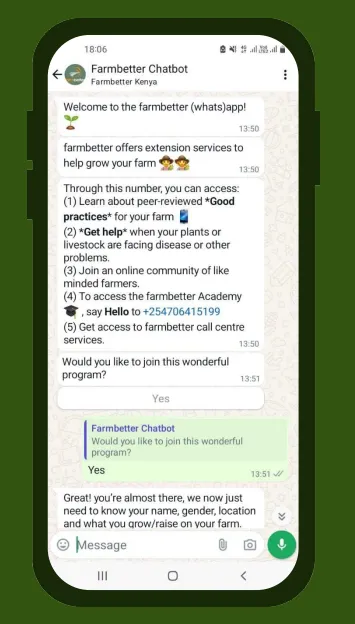
Farmbetter is a Kenya-based digital agriculture company deploying AI-powered solutions to enhance climate resilience, productivity, and income for smallholder farmers across Africa and India. The organisation delivers a 3-in-1 digital platform comprising a WhatsApp chatbot for farmers, a mobile application for extension advisors, and an organisation-facing dashboard. The platform integrates soil health data, weather forecasts, pest and disease intelligence, and market information to generate real-time, personalised, climate-smart agricultural recommendations. Designed for low-bandwidth and low-literacy contexts, farmbetter enables farmers to access advisory services directly via widely used communication channels. Operating across eight African countries and India, farmbetter supports over 50,000 farmers, strengthening climate adaptation, reducing post-harvest losses, and improving yields. Through projects such as AgriPath in India, the organisation demonstrates cross-regional scalability and contextual adaptability.
AI Technology Used
Key Outcomes
Efficiency & Productivity
Economic Value Creation
Access & Reach
Inclusion & Equity
Resilience & Risk Reduction
Resource Efficiency
Accuracy & Quality Improvement
farmbetter is revolutionising agricultural resilience for Africa and India's most vulnerable farmers. By delivering AI-powered, real-time advisory services through accessible channels like WhatsApp, farmbetter has enabled over 50,000 smallholder farmers across eight countries to increase yields by 20–30% and reduce post-harvest losses by 15%. The platform integrates soil health data, weather forecasts, and pest intelligence to generate personalised, climate-smart recommendations tailored to low-bandwidth, low-literacy contexts. Operating at the intersection of climate adaptation and economic empowerment, farmbetter demonstrates how scalable digital solutions can bridge critical gaps in traditional extension systems, strengthen food security, and build lasting resilience against climate variability - one farmer, one decision, one harvest at a time.
Impact Metrics
Yield increase among farmers using farmbetter AI advisory platform
Baseline Value
Conventional farming practices without AI-driven decision support Percentage
Post-Implementation
20 –30% increase in crop yields
Reduction in post-harvest losses through predictive and advisory support
Baseline Value
Standard post-harvest handling without AI-based advisory Percentage
Post-Implementation
15 % reduction in post-harvest losses
Farmers reached through AI-powered digital advisory platform
Baseline Value
Limited access to personalised, real-time advisory services Farmers
Post-Implementation
More than 50,000 farmers reached across 8 African countries Farmers
Implementation Context
Kenya and India
50,000+ smallholder farmers across 8 African countries, smallholder farmers in India under AgriPath collaboration, extension advisors, farmer-facing organisations
Key Partnerships
Replicability & Adaptation
- Localisation required for crop types and agro-climatic conditions
- Integration with local extension systems enhances adoption
- Designed for low-bandwidth and low-literacy environments
Supporting Materials

* The data presented is self-reported by the respective organisations. Readers should consult the original sources for further details.