


Alphakhoj: NeuroAI-Powered Multilingual Literacy Platform for Inclusive Learning

India
Education
Accessibility
Implementing Organisation
AlphaKhoj
India, Pan-Country
Implementing Point of Contact
Manusmriti Agarwal
Research and Strategy Lead
Contributor of the Impact Story
Changeinkk
Year of implementation
2025
Problem statement
India’s foundational literacy crisis disproportionately affects neurodiverse children, particularly those with Specific Learning Disabilities (SLDs) such as dyslexia and dysgraphia. Fewer than one in four children showing signs of learning differences receive timely and effective support, largely due to limited early identification mechanisms, shortages of trained special educators, and remediation approaches that are not aligned with classroom curricula. The challenge is further compounded by multilingual and code-switching learning environments, where differences between home and school languages increase cognitive load and reduce the effectiveness of traditional interventions. As a result, many children fall behind silently, losing confidence before meaningful support reaches them. Poor foundational literacy not only constrains individual educational attainment but also contributes to long-term socioeconomic consequences, including reduced workforce participation and increased reliance on remedial and welfare systems.
Submission Overview
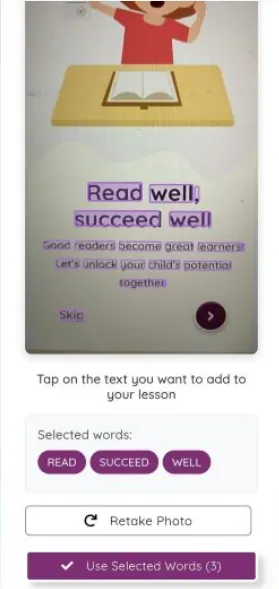
Alphakhoj is a NeuroAI-powered multilingual literacy platform based in India. The organisation works at the intersection of neuroscience, learning science, and artificial intelligence to design inclusive, scalable literacy solutions for neurodiverse and mainstream learners. Alphakhoj positions itself not merely as an edtech application but as a learning-engineering infrastructure. It integrates computer vision and generative AI to convert textbook content into curriculum-aligned, multisensory learning experiences across eight Indian languages. The platform is co-designed with special educators, parents, and children, ensuring contextual relevance and usability.
AI Technology Used
Computer Vision, Natural Language Processing
Key Outcomes
Access & Reach
Alphakhoj addresses India’s foundational literacy crisis, which disproportionately affects neurodiverse children, particularly those with Specific Learning Disabilities (SLDs), in multilingual and code-switching classrooms where fewer than one in four children showing signs of dyslexia or dysgraphia receive timely support. Limited linguistically appropriate screening tools, shortages of special educators, and curriculum misalignment leave many children falling behind, with long-term educational and economic consequences. Through a neuroscience-grounded, AI-enabled learning engineering platform, Alphakhoj transforms any textbook page into curriculum-aligned, multisensory literacy games across eight Indian languages, functioning as both a gamified intervention and a stealth assessment system. Thus, by shifting from deficit-focused assessment to strength-based, adaptive learning pathways, Alphakhoj enables supervision-free, affordable, and scalable literacy support for neurodiverse learners while benefiting all children.
Impact Metrics
Frequency of practice opportunities
Baseline Value
NA
Post-Implementation
Each skill is revisited 15-20 times more than normal across multiple games, sensory and content contexts
Children's ability to read with speed and accuracy
Baseline Value
NA
Post-Implementation
Improvements in reading fluency were seen for early deployments across diverse learners
Children's ability to maintain focus and participation in learning activities
Baseline Value
NA
Post-Implementation
Improvements in sustained engagement was noted in early deployments
Implementation Context
India
Neurodiverse and neurotypical children, particularly from low-resource settings, special educators, teachers, and parents
Key Partnerships
Replicability & Adaptation
Supporting Materials

* The data presented is self-reported by the respective organisations. Readers should consult the original sources for further details.