


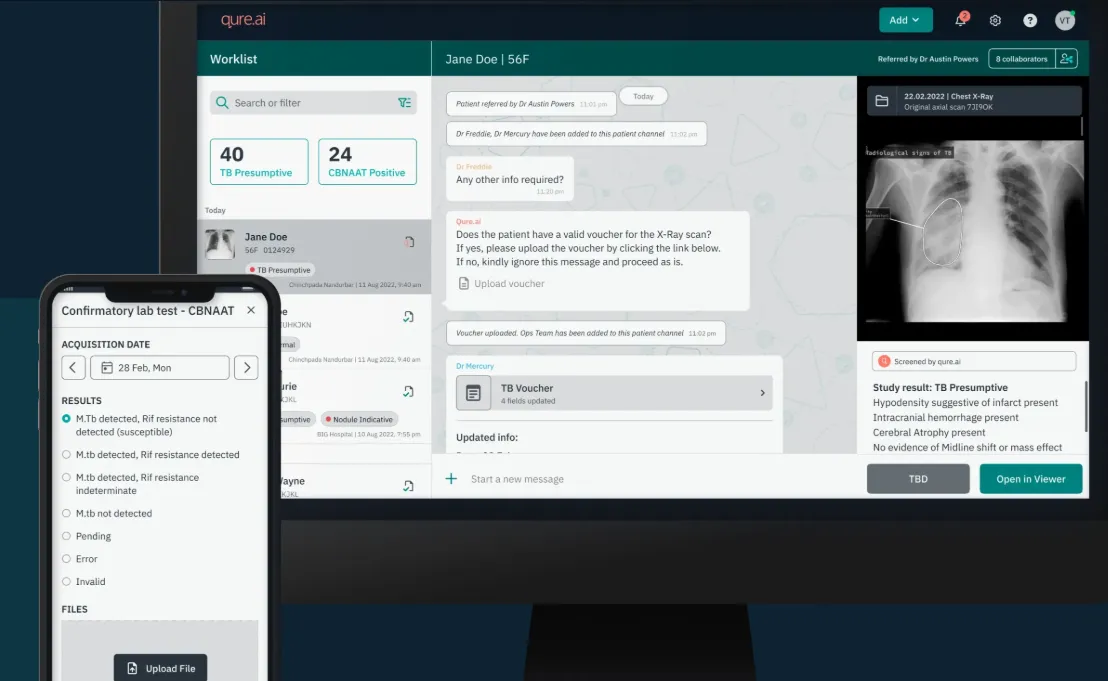
Qure.ai: AI-Assisted Tuberculosis Screening

India
Healthcare
Implementing Organisation
Qure.AI
India, Maharashtra, Mumbai
Implementing Point of Contact
Prashant Warier
Co-founder and CEO
Contributor of the Impact Story
World Bank
Year of implementation
2022
Problem statement
Tuberculosis (TB) remains under-detected in many low-resource settings, particularly among asymptomatic or hard-to-reach populations. Conventional symptom screening misses many cases, and expert radiological interpretation is scarce. There is a need to improve active case finding (ACF) and reduce TB transmission by using scalable diagnostic tools that work in community settings. The ultraportable chest X-rays interpreted by artificial intelligence (AI) to improve tuberculosis (TB) screening in remote Nigeria. The AI software analyses X-ray images for TB abnormalities, flagging individuals for confirmatory testing.
Submission Overview
Qure.AI is an Indian healthtech company founded to democratise healthcare through artificial intelligence. The organisation develops AI-powered diagnostic solutions that address critical gaps in medical imaging interpretation, particularly in resource-constrained settings. Their flagship tuberculosis screening platform combines ultra-portable chest X-rays with computer vision algorithms to enable accurate, scalable TB detection without requiring specialist radiologists. Deployed across India and globally since 2022, Qure.AI partners with health ministries, NGOs, and community organisations to reach underserved populations. The company's mission centers on making quality diagnostics accessible and affordable, transforming disease detection in remote communities where traditional infrastructure is unavailable or cost-prohibitive.
AI Technology Used
Key Outcomes
Access & Reach
Inclusion & Equity
Accuracy & Quality Improvement
Qure.AI uses ultra-portable chest X-rays, which are interpreted by AI, to improve tuberculosis detection in remote Nigerian communities. The approach nearly halves the cost per TB case detected compared to symptom-only screening. Overall, the platform enables active TB detection at community scale without requiring specialist infrastructure.
Impact Metrics
Cost per TB case detected under symptom-only versus AI-assisted screening
Baseline Value
Symptom screening for a cough of more than 2 weeks resulted in a cost of US$ 1,198 per TB case detected, and had lower referral efficiency and higher missed cases Cost per case detected in US Dollars ($)
Post-Implementation
By using the Qure.AI-assisted chest X-ray combined with symptom screening, the cost was reduced to US$ 636–773 per TB case detected Cost per case detected in US Dollars ($)
Referral efficiency and diagnostic follow-through in TB screening
Baseline Value
Symptom-only screening showed lower referral efficiency and more missed cases Percentage
Post-Implementation
With a Qure.AI chest X-ray abnormality threshold ≥ 0.30, 96% of individuals flagged by AI successfully provided sputum samples for diagnostic testing Percentage
Cost-effectiveness of AI-assisted TB screening interventions
Baseline Value
Traditional symptom-based algorithms detected 85 confirmed TB cases at higher total intervention costs Number of TB cases detected, incremental cost-effectiveness ratio, and total intervention cost
Post-Implementation
AI-assisted screening detected the same 85 confirmed TB cases at lower total cost, resulting in improved incremental cost-effectiveness Number of TB cases detected, incremental cost-effectiveness ratio, and total intervention cost
Implementation Context
Global deployment in over 105 countries.
TB-affected individuals in high-burden settings, frontline health workers, diagnostic facilities in low-resource countries
Key Partnerships
Stop TB Partnership, Janna Health Foundation, SUFABEL Community Development Initiative (Nigeria), Nigeria National TB and Leprosy Programme, and GeneXpert laboratory network
Replicability & Adaptation
Supporting Materials

* The data presented is self-reported by the respective organisations. Readers should consult the original sources for further details.