


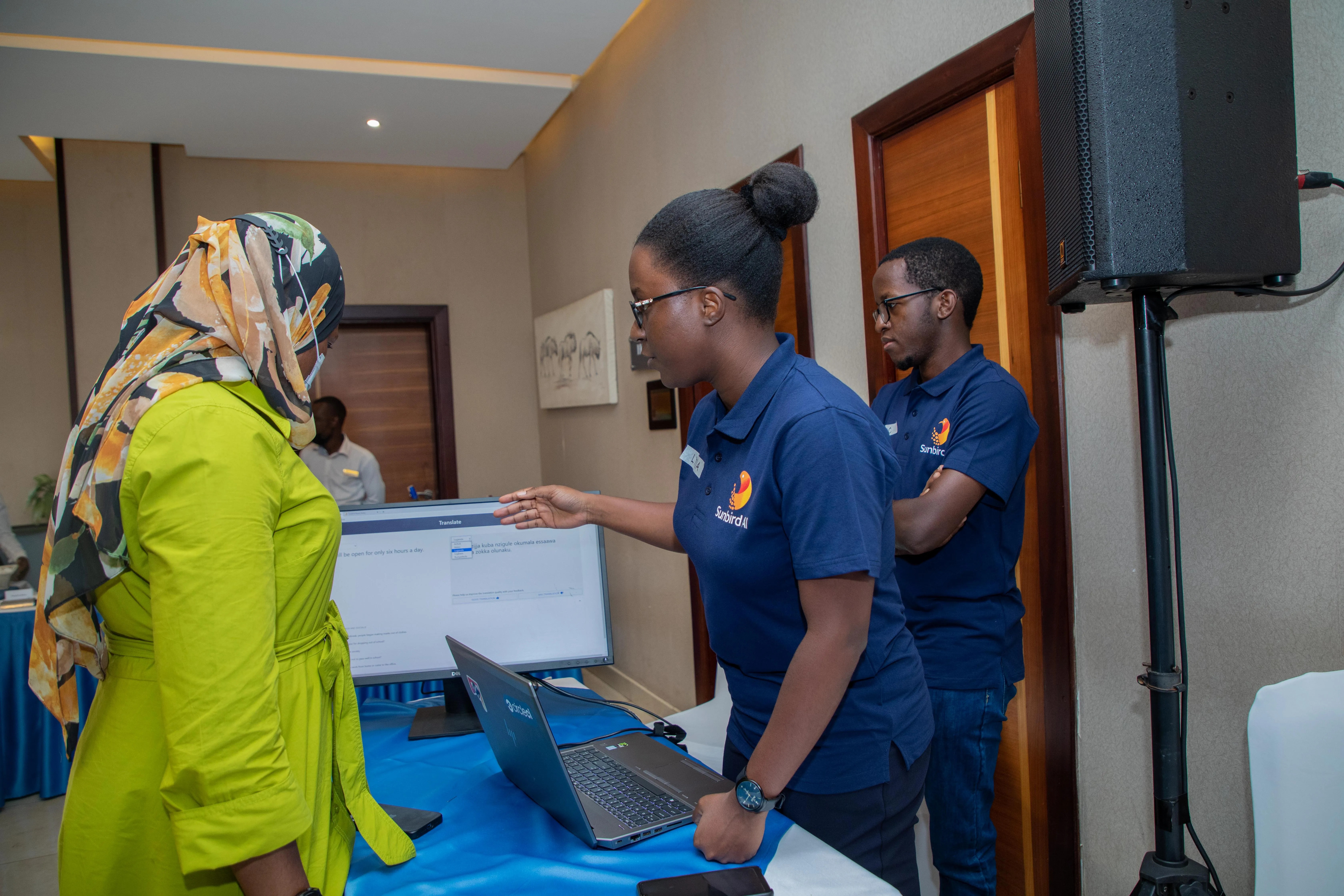
Sunbird African Language Technology (SALT): African Natural Language Processing for Inclusion and Empowerment

Uganda
Education
Digital Inclusion & Language Technology
Implementing Organisation
Sunbird AI
Uganda, Kampala
Implementing Point of Contact
Nimpamya Janat Namara
Communications and Engagement Lead
Contributor of the Impact Story
Carnegie India
Year of implementation
2025
Problem statement
Current Global AI systems have a systemic "language data gap" that effectively excludes millions of African language speakers from the global digital ecosystem. Because most foundational models are trained on dominant high-resource languages, a digital divide emerges that prevents equal access to critical information and life-saving resources. This linguistic barrier directly hinders the achievement of social development goals; it restricts access to quality educational materials, impedes healthcare equity, and limits access to legal justice for those who cannot communicate in English. Beyond public services, this exclusion prevents millions from participating in the digital economy, as essential commerce, financial services, and market information remain linguistically inaccessible. SALT (Sunbird African Language Technology) addresses this by building high-quality, open-source datasets and Natural Language Processing (NLP) tools specifically for African contexts. By making these languages digitally functional, it ensures that technological advancement fosters genuine inclusion - empowering underserved communities to access information, express their needs, and thrive in an increasingly connected world.
Submission Overview
Sunbird AI is a non-profit organisation that builds open-source, practical AI systems to address social initiatives in Africa. They focus on the end-to-end development of AI tools, from localised data collection to the deployment of scalable applications. While Sunbird is widely recognised for our pioneering work in Language Technology—specifically creating high-quality datasets and translation models for underserved African languages to bridge the digital divide—our scope extends to a variety of data-driven sectors. Beyond NLP, we leverage AI for social impact in areas such as environmental monitoring and public policy, ensuring that the benefits of the fourth industrial revolution are accessible to marginalised communities.
AI Technology Used
Speech Recognition
Key Outcomes
Efficiency & Productivity
Access & Reach
Inclusion & Equity
Accuracy & Quality Improvement
Knowledge & Skills Impact
Resource Efficiency
User Experience & Satisfaction
Sunbird AI has built open-source language technology infrastructure to bridge the digital divide for millions of underserved African language speakers by making AI systems accessible in their native languages. The SALT (Sunbird African Language Technology) platform has achieved significant scale with over 3,500 active users and 80,800 dataset downloads globally, demonstrating widespread adoption of locally-relevant AI tools. The infrastructure supports 31 African languages and has reduced local-language content production time by 33-66%, making information access and digital services economically viable for communities previously excluded from the digital economy. SALT's translation models and speech recognition tools have been downloaded over 2,400 times, enabling government agencies, NGOs, and businesses across East Africa to deliver critical services—from healthcare information to legal resources—in languages that communities actually speak, fostering genuine digital inclusion for populations historically marginalised by language barriers.
Impact Metrics
Model downloads for Sunflower and SALT-Whisper models
Baseline Value
NA Number of downloads
Post-Implementation
Sunflower and SALT-Whisper models had more than 2,400 downloads Number of downloads
User adoption of SALT models, API, and web interface
Baseline Value
NA Number of Users
Post-Implementation
SALT AI solutions have more than 3,500 users Number of Users
Number of languages supported by the SALT Infrastructure
Baseline Value
NA Number
Post-Implementation
31 languages
Global impact of the open-source SALT dataset
Baseline Value
NA Number of downloads
Post-Implementation
More than 80,800 downloads have been recorded Number of downloads
Time saved in local-language content production due to SALT
Baseline Value
NA Percent
Post-Implementation
A time reduction of 33 to 66 percent has been recorded Percent
Implementation Context
Uganda, East Africa
Underserved speakers of indigenous languages (e.g., Luganda, Acholi, Ateso, Swahili), Government agencies, NGOs, and digital businesses that require local-language integration for service delivery. Current users are over 3,500 as of 2025. Target users are speakers of indigenous languages (e.g., Luganda, Acholi, Ateso, Swahili), government agencies, NGOs, and digital businesses requiring local-language integration.
Key Partnerships
Ministry of ICT and National Guidance, Secretariat of Science, Technology and Innovation (STI), Uganda Bureau of Statistics (UBOS), National Information Technology Authority (NITA-U), SEMA, TRAC FM, Amara Hub, Cente Tech, Backup Uganda, Makerere AI Lab, and Infectious Diseases Institute (IDI)
Replicability & Adaptation
- NLP/AI Engineers, Data Annotators, Native Language Linguists, and Community Engagement Leads
- GPU Infrastructure, vLLM Inference Stack, Scalable Cloud Storage, API Gateway
- Funding for localised data digitisation and open-source infrastructure maintenance
Supporting Materials

* The data presented is self-reported by the respective organisations. Readers should consult the original sources for further details.