


TRST01Chain: AI-Enabled Traceability for Deforestation-Free Agriculture and Carbon Markets

Côte d’Ivoire
Agriculture
Implementing Organisation
TRST01 Global Ventures Pte Ltd
Côte d’Ivoire, Pan-Country
Headquartered in Central Singapore Community Development Council, Singapore. Scaled deployment has taken place in Côte d’Ivoire. Also in Indonesia, Malaysia, Thailand, Vietnam, Laos, Côte d'Ivoire, DRC, Malawi.
Implementing Point of Contact
Lin Kennard
Vice President
Contributor of the Impact Story
Government of Maharashtra’s AI and Agritech Innovation Center, World Bank Group, Wadhwani AI
Year of implementation
2023
Problem statement
Global agricultural supply chains and carbon markets face persistent challenges including fragmented smallholder data, deforestation risk, weak monitoring systems, and increasing regulatory requirements such as the EU Deforestation Regulation (EUDR) and Paris Agreement reporting obligations. Smallholder-dominated systems often lack verifiable land mapping, identity continuity, yield validation, and automated compliance reporting, leading to costly audits, exclusion from export markets, and limited access to climate finance. Simultaneously, sovereign climate governance systems in emerging economies frequently lack integrated digital infrastructure for emissions tracking, forest monitoring, and carbon credit registry management. These gaps undermine environmental integrity, market trust, and equitable participation in climate finance. Addressing these challenges requires scalable, standards-aligned digital infrastructure that integrates AI-driven geospatial analytics, deforestation detection, identity systems, and automated monitoring, reporting, and verification across both agricultural supply chains and national climate governance systems.
Submission Overview
TRST01 Global Ventures Pte Ltd is a Singapore-based digital climate governance and traceability company deploying AI-enabled infrastructure across agricultural supply chains and sovereign carbon systems in the Global South. The organisation builds standards-aligned digital systems to enhance compliance, transparency, and climate integrity in fragmented smallholder ecosystems. Through its platforms TRST01Chain and TRST01Veritas, TRST01 integrates artificial intelligence, geospatial analytics, blockchain-based registries, and automated monitoring, reporting, and verification (MRV) workflows. The company operates across Southeast Asia and Africa, supporting exporters, cooperatives, governments, and climate finance institutions in meeting evolving regulatory requirements such as the EU Deforestation Regulation (EUDR) and Article 6 of the Paris Agreement. TRST01 focuses on smallholder inclusion, digital farmer identity systems, deforestation risk detection, ESG compliance, and sovereign climate registry digitisation. Its deployments span multi-commodity supply chains including rubber and coffee, as well as national-scale carbon governance platforms.
AI Technology Used
Key Outcomes
Efficiency & Productivity
Economic Value Creation
Access & Reach
Inclusion & Equity
Accuracy & Quality Improvement
Resource Efficiency
Resilience & Risk Reduction
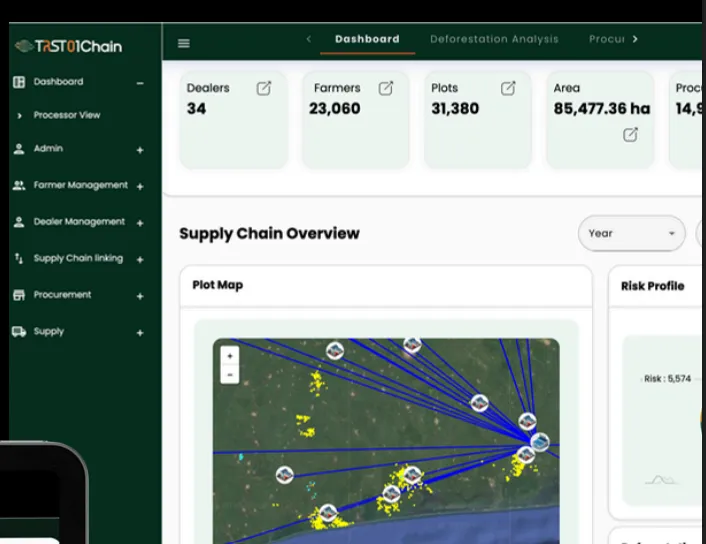
Since 2023, TRST01 Global Ventures has deployed AI-enabled traceability and digital climate governance systems across Southeast Asia and Africa to address fragmented smallholder data, deforestation risk, and rising regulatory requirements. Through TRST01Chain, more than 250,000 hectares in Southeast Asia and 84,000 hectares in Côte d’Ivoire have been geospatially mapped and screened for compliance, integrating over 150,000 farmers in Southeast Asia and 60,000 farmers in Côte d’Ivoire into structured digital traceability systems. More than 35 cooperatives and multiple exporter networks have been onboarded, strengthening audit readiness and due diligence under frameworks such as EUDR. Through TRST01Veritas, the model is extending to sovereign climate systems in the Democratic Republic of the Congo and Malawi, supporting national carbon registry digitisation and AI-enabled monitoring, reporting, and verification. Together, these deployments demonstrate scalable improvements in transparency, compliance efficiency, climate data integrity, and smallholder inclusion across agricultural supply chains and carbon markets.
Impact Metrics
Agricultural land digitised and mapped under TRST01Chain AI-enabled traceability
Baseline Value
Fragmented, non-digitised land records Hectares
Post-Implementation
250 ,000+ hectares mapped in Southeast Asia and 84,000+ hectares in Côte d’Ivoire
Smallholder farmers integrated into TRST01Chain digital traceability system
Baseline Value
Limited traceability and identity continuity Farmers
Post-Implementation
150 ,000+ farmers (Southeast Asia) and 60,000+ farmers (Côte d’Ivoire)
Cooperatives and exporter networks onboarded to TRST01Chain platform
Baseline Value
Informal aggregation with limited digital oversight Number of organisations benefitted
Post-Implementation
More than 35 cooperatives and multiple exporter networks integrated Number of organisations benefitted
Implementation Context
Southeast Asian countries including Indonesia, Malaysia, Thailand, Vietnam, Laos, and African countries including Côte d’Ivoire, Democratic Republic of the Congo, and Malawi
150,000+ smallholder farmers across Southeast Asia, 60,000+ smallholder rubber farmers and 35+ cooperatives in Côte d’Ivoire, national regulators, forest authorities, carbon project developers, exporters, aggregators, multinational buyers, and climate finance stakeholders
Key Partnerships
Replicability & Adaptation
- Requires regulatory alignment with local forest and trade laws
- Must integrate with local land tenure systems
- Requires government buy-in for sovereign carbon registry systems
- Localisation of farmer onboarding workflows critical
Supporting Materials

* The data presented is self-reported by the respective organisations. Readers should consult the original sources for further details.