


AtenIA: An AI-Assisted Interactive Mentorship Platform for STEM Education

Peru
Education
Implementing Organisation
STEMLAB
Peru, Ancash, Arequipa, Cajamarca, Cusco, Huancavelica, Junín, Lambayeque, Lima, Moquegua, Pasco, Tacna, Pan-Region
Implementing Point of Contact
Nataly Vasquez Alzamora
CEO
Contributor of the Impact Story
UN Women
Year of implementation
2025
Problem statement
In Peru, despite economically vital sectors driving national development, a significant gender gap persists in STEM fields. Gender stereotypes take root early, nine out of ten young girls aged 6–8 associate engineering with masculine skills. These self-limiting beliefs are reinforced by cultural stereotypes framing key economic industries as masculine environments, preventing the country from leveraging approximately half of its potential talent pool. Traditional non-AI educational tools like static textbooks have proven insufficient to provide the personalised, interactive mentorship needed to challenge entrenched biases and inspire the next generation of women leaders.
Submission Overview
STEMLAB developed the AtenIA initiative, leveraging its team of education experts who curate content for the AI system to ensure accuracy, authenticity, and safety. The organisation specialises in technology-enabled educational solutions designed to address gender gaps in STEM fields. STEMLAB operates through collaborative partnerships with non-profit organisations, social enterprises, and allies from the Peruvian government, who play promotional roles in advancing the initiative. The organisation also engages industry leaders from civil society and the private sector to build the partnerships necessary for nationwide scaling and sustainable impact.
AI Technology Used
Speech Recognition, Machine Learning
Key Outcomes
Access & Reach
Inclusion & Equity
AtenIA, a specialised AI assistant developed by STEMLAB produced significant shifts in girls' career aspirations and perceptions of STEM fields. Participants' intention to pursue STEM careers increased from 9 per cent to 76 per cent, an 8.4-fold increase. The exposure to diverse role models expanded notably: before the intervention, 85 per cent of participants identified only their mother as a female role model, while afterward, 95 per cent also recognised female engineers featured in the book as role models. Additionally, 93 per cent of users reported recognising women as active contributors in sectors critical to national development, and 92 per cent demonstrated increased understanding of STEM's importance, challenging perceptions of STEM as an exclusively male domain. This case demonstrates how generative AI can help address gender gaps in STEM education.
Impact Metrics
Percentage of participants reporting intention to pursue a career in STEM fields.
Baseline Value
9 % of female students assessed reported intention of pursuing STEM
Post-Implementation
Following the intervention, 76% of participants intended to pursue a STEM career.
Percentage of participants identifying female engineers (beyond family members) as role models.
Baseline Value
85 % of participants identified their mother as their only female role model, with no participants identifying female engineers as role models.
Post-Implementation
95 % of participants identified female engineers featured in the book as role models.
Percentage of users recognising women as active contributors in sectors critical to national development.
Baseline Value
NA
Post-Implementation
Following the intervention, 93% of users reported recognising women as active contributors in sectors critical to national development
Percentage of participants demonstrating increased understanding of the importance of STEM fields.
Baseline Value
NA
Post-Implementation
After the intervention, 92% of participants demonstrated an increased understanding of the importance of STEM fields.
Implementation Context
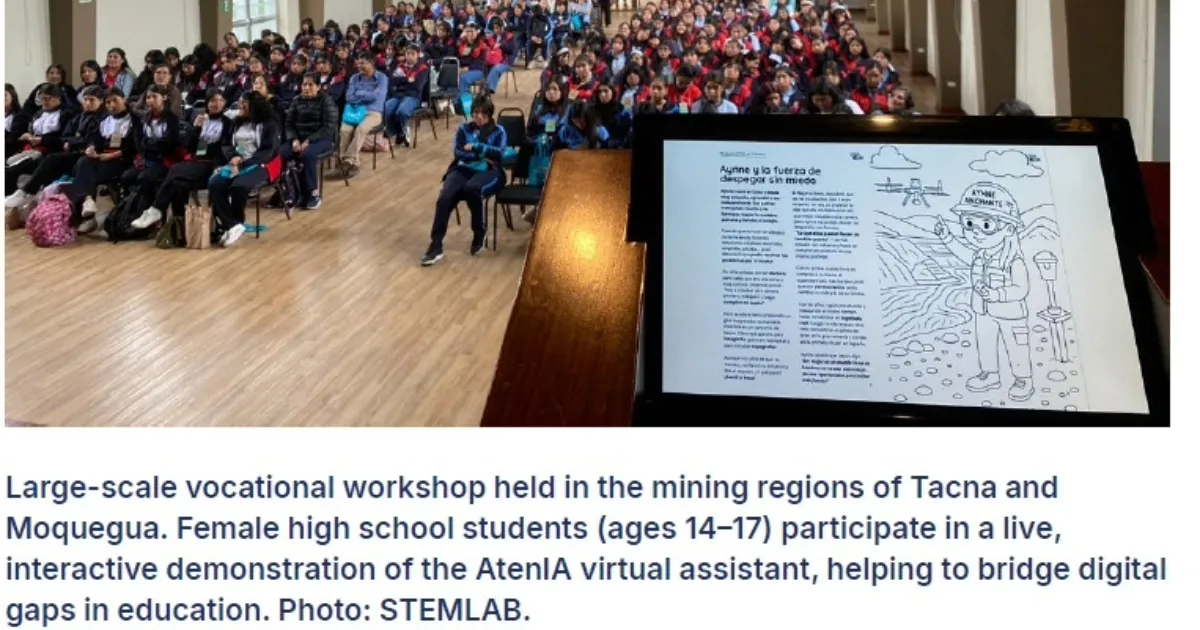
Across 11 regions in Peru including Ancash, Arequipa, Cajamarca, Cusco, Huancavelica, Junín, Lambayeque, Lima, Moquegua, Pasco, and Tacna.
Over 1,500 students and 120 teachers covering 200 rural Andean communities
Key Partnerships
Peruvian Government, Sociedad Nacional de Minería, Petróleo y Energía (SNMPE)
Replicability & Adaptation
- Solution must be adapted to local cultural contexts, addressing region-specific attitudes toward girls' STEM education
- Strategies required to explicitly address digital divides, as AI interaction requires internet connectivity which may limit real-time engagement in highly remote areas
- Integration of physical materials with AI components is essential to overcome infrastructural barriers in underserved regions
- Use tangible, offline-capable materials as anchors before introducing digital mentorship components
- Design should enable personalised mentorship while maintaining scalability across diverse geographic regions
- Plan for sustained sensitisation efforts in communities where STEM education for girls may face initial resistance
* The data presented is self-reported by the respective organisations. Readers should consult the original sources for further details.