


Policy Pulse: Driving Policy Data to On-Ground Impact

India
Other
Governance and Civic Technology
Implementing Organisation
Civic Innovation Foundation/‘Civis’
India, Maharashtra, Mumbai
Implementing Point of Contact
Antaraa Vasudev
Chief Executive Officer
Contributor of the Impact Story
Tata Trusts
Year of implementation
2025
Problem statement
While legislative frameworks like India’s Pre-Legislative Consultation Policy (PLCP) and global OECD guidelines mandate public feedback on draft laws, existing civic engagement infrastructure has failed to keep pace with skyrocketing digital participation. Driven by increased internet penetration, public consultation volume has surged by 2000%+ since 2014. Single legislative issues now regularly generate millions of responses, which arrive scattered across fragmented formats including emails, physical letters, and disparate online portals. Consequently, government bodies face an overwhelming logistical bottleneck. Consolidating, analyzing, and extracting actionable policy insights from this massive influx of unstructured public data has become nearly impossible under manual systems. This operational strain slows down legislative timelines, compromises the quality of decision-making, and severely widens the citizen-government divide. To bridge this gap, there is a critical need for a streamlined, secure, and highly scalable Digital Public Infrastructure (DPI). Leveraging advanced AI and language technologies is essential to automate feedback synthesis, ensuring democratic participation remains accessible to all citizens—regardless of literacy or geography—while providing policymakers with manageable, data-driven insights.
Submission Overview
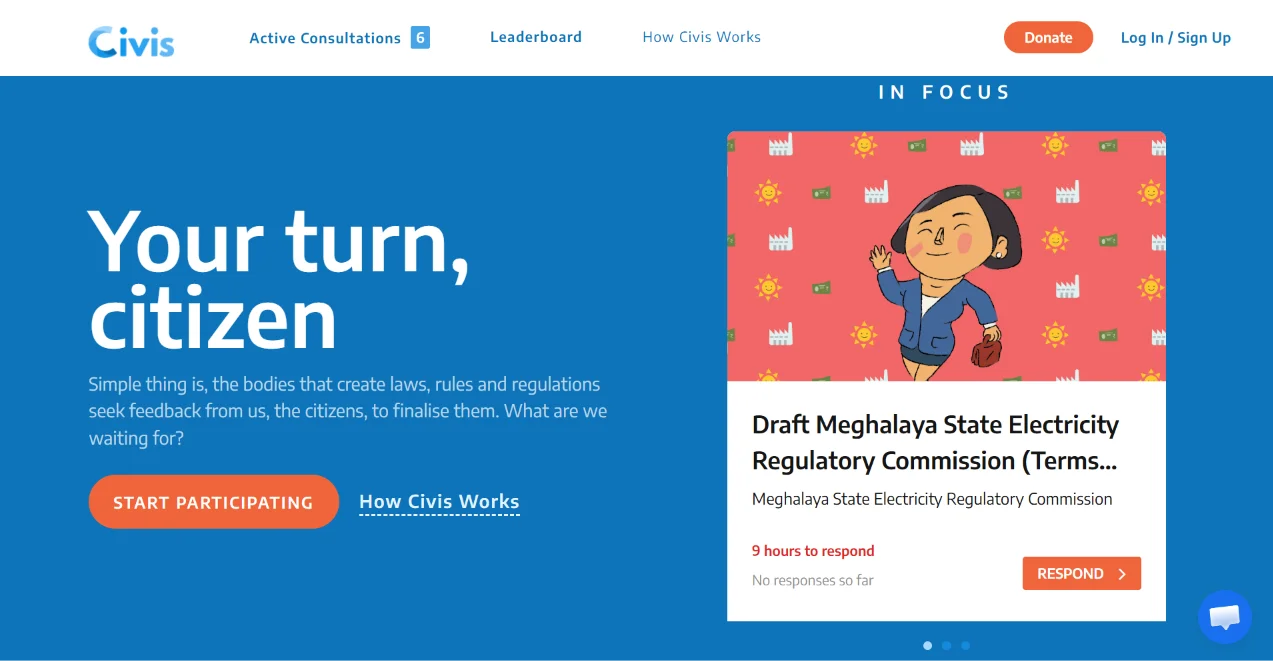
Civis (www.civis.vote) is a Section 8 non-profit organisation that works with governments to make policymaking more participatory, inclusive, and evidence-based through the use of civic technology. By designing and managing end-to-end public consultations, Civis enables governments to engage meaningfully with citizens and stakeholders, simplifying complex policy documents, conducting targeted outreach, collecting diverse feedback, and transforming public inputs into actionable policy insights. Since its inception, Civis has facilitated consultations on over 1,300 draft laws and policies, gathering more than 9 lakh points of feedback from citizens across 777+ cities and towns in India. To make public consultations more efficient, scalable, and actionable, Civis has developed AI-powered tools that strengthen governance and improve policymaking. Supported by the IndiaAI Mission, its suite of solutions leverages Artificial Intelligence to analyse public feedback, identify gaps in draft policies, interpret complex policy documents, and support data-driven decision-making. By combining technology, policy expertise, and stakeholder engagement, Civis helps governments build more transparent, responsive, and citizen-centric public institutions.
AI Technology Used
Key Outcomes
Efficiency & Productivity
Access & Reach
Inclusion & Equity
Accuracy & Quality Improvement
User Experience & Satisfaction
Resource Efficiency
Civis tackles a growing problem in democratic governance: public consultations now generate far more feedback than governments can manually read, sort and act on. Its AI-supported platform turns large volumes of citizen input into insights policymakers can use, with a voice-first design that works across urban, rural and underserved communities. Over the past year, citizen engagement through Civis-supported consultations grew from about 38,500 to over 911,000 people, and the platform now works with 41 government bodies in India and one in South Africa. Officials across Central and State departments used customised tools and dashboards to enable departments to accept or reflect between 37% and 72% of citizen inputs in their final policies. Policy Pulse shows how civic technology can help governments listen at scale and respond.
Impact Metrics
Consultation inputs accepted
Baseline Value
Not applicable, as acceptance can only be measured after consultation feedback has been reviewed Percentage of actionable consultation inputs incorporated into, or acknowledged through, the revised policy or formal government response
Post-Implementation
37 % to 72% of citizen inputs accepted or reflected by departments
Government use of customised tools and dashboards
Baseline Value
Not available, as usage was not previously tracked consistently Government officials engaged through customised software and tools; number of dashboards deployed; and tool sessions recorded
Post-Implementation
Eight customised software solutions were developed for government partners and used by 125+ government officials and policymakers across Central and State Government departments. Civis also deployed 12 government dashboards, which recorded 94 tool sessions. Government officials engaged through customised software and tools; number of dashboards deployed; and tool sessions recorded
Citizens engaged
Baseline Value
38,512 Cumulative citizens engaged through Civis-supported public consultations
Post-Implementation
Approximately 911,328 Cumulative citizens engaged through Civis-supported public consultations
Quality of responses
Baseline Value
Indexed at 100 Average response-quality score based on Civis’ internal assessment framework
Post-Implementation
127.86 Average response-quality score based on Civis’ internal assessment framework
Implementation Context
India, South Africa
Civis has worked to gether feedback from 0.9 million citizens in India - across urban, rural, underserved and disparate demographics. Our voice first approach makes the stack particularly easy to use in diverse contexts.
Key Partnerships
Civis has worked with 41 Government Bodies in India and 1 in South Africa. Additionally we have over 20 Civil Society Partners in India and beyond.
Replicability & Adaptation
The source code is structured through a modular, microservices-oriented architecture, with specific repositories maintained for different tools and capabilities under the Civis GitHub organisation: https://github.com/civis-vote. The main application is also maintained through separate frontend and backend repositories, making it easier to customize, extend, and sustain in different deployment contexts. For adaptation in new geographies or institutional settings, the platform can be configured for local languages, policy domains, consultation formats, stakeholder groups, and deliberation methodologies. In addition to open-source deployment, the Civis team also provides managed hosting and implementation support, including assistance with application hosting, workflow customisation, consultation design, AI model configuration, and adaptation to different public participation or deliberative governance processes.
* The data presented is self-reported by the respective organisations. Readers should consult the original sources for further details.