


Project Saathi: Scalable AI for Gender-Responsive Health

India
Healthcare
Implementing Organisation
WizLearnr
India, Maharashtra, Telangana, Select districts in Maharashtra and Telangana
Implementing Point of Contact
Madhavi Kaivalya Kandalam
Author/Researcher
Contributor of the Impact Story
UN Women
Year of implementation
2025
Problem statement
Women in the Global South face systemic barriers to healthcare access, where their needs are deprioritised due to unpaid care responsibilities, limited service availability, requirements for family consent and financial constraints. Over 1.2 billion women experience at least one micronutrient deficiency. Existing AI health systems reflect male-dominated medical research and gender bias in datasets. For e.g., AI models are significantly more likely to miss liver disease in women than men. In LMICs, language barriers and the digital divide compound these gaps. Non-AI solutions cannot provide continuous, scalable symptom triage at home.
Submission Overview
WizLearnr is the developer of Project Saathi, working with domain experts and female community leaders through early pilots and community validation activities using a train-the-trainer model. The solution draws on Indic language models and creates gender-disaggregated health datasets.
AI Technology Used
Speech Recognition, Indic Language Models, Voice-Based Conversational AI, Gender-Disaggregated Dataset Architecture
Key Outcomes
Access & Reach
Inclusion & Equity
Efficiency & Productivity
Accuracy & Quality Improvement
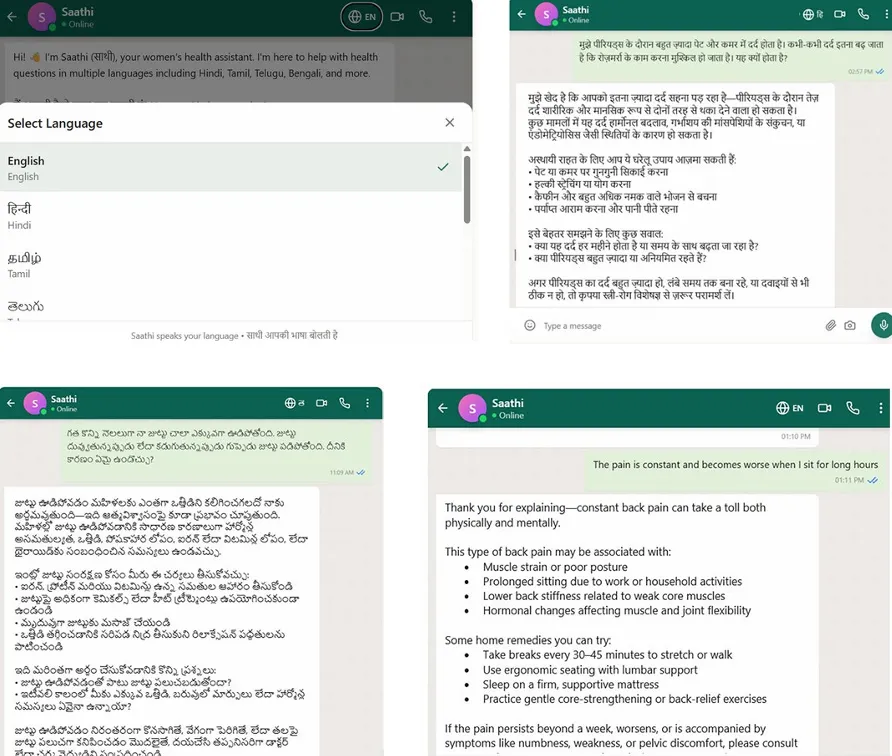
Project Saathi is a vernacular, voice-based AI health system designed for women in low- and middle-income countries, supporting symptom interpretation and care-seeking through local-language conversations on basic smartphones. Drawing on evidence from comparable pilots, Saathi aims to increase early care-seeking among women by 30%. Evidence shows 80%+ agreement between reproductive health symptom checkers and GP assessments, indicating strong potential to reduce diagnostic delays. The system enables at-home triage saving 2-4 hours per visit and reducing travel costs, while creating women-centric health datasets to mitigate algorithmic gender bias.
Impact Metrics
Degree of AI-GP Agreement on Symptom Assessment
Baseline Value
NA
Post-Implementation
More than 80% agreement has been recorded between reproductive health symptom checkers and general practitioner assessments.
Time Saved Per Visit due to WizLearnr's at-home triage
Baseline Value
Multiple hours spent traveling to healthcare facilities
Post-Implementation
At-home triage saving estimated 2-4 hours per visit and reducing travel-related costs.
Number of households targeted during the pilot stage
Baseline Value
NA
Post-Implementation
500 households
Implementation Context
Initial pilots in select districts of Maharashtra and Telangana in India. State-wide pilots have also been planned for 2026, with a pan-India deployment targeted for 2027.
Adult women in low-income, informal or rural settings
Key Partnerships
Domain health experts and female community leaders
Replicability & Adaptation
- Balance awareness with anxiety reduction in AI outputs
- Actively address digital divide (shared device use, privacy)
- Invest in women-centric datasets for local health contexts
- Adapt voice/speech-to-text for dialectal variation
- Sustained community engagement to build trust
The framework is designed to be extensible to other domains (e.g., financial literacy). Vernacular-first, voice-enabled and home-based access is critical for inclusion. The train-the-trainer model leveraging community trust proved effective.
* The data presented is self-reported by the respective organisations. Readers should consult the original sources for further details.