


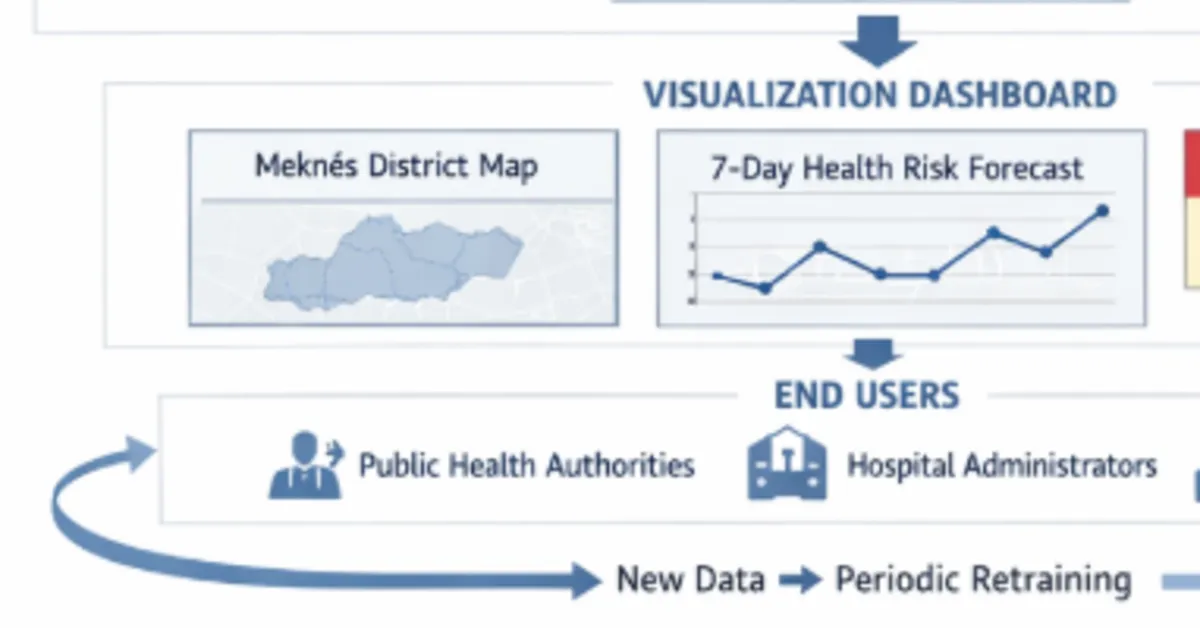
OCT7 Intelligence System Framework: AI-Driven Environmental Health Risk Prediction in Urban Morocco

Morocco
Healthcare
Implementing Organisation
Bio-Actives, Health & Environment Laboratory, Faculty of Sciences, Moulay Ismail University of Meknes
Morocco, Fès-Meknès, Meknès
Implementing Point of Contact
Youssef Hajja
FSM
Contributor of the Impact Story
World Health Organization (WHO)
Year of implementation
2023
Problem statement
Urban environments in the Global South are increasingly exposed to environmental health risks driven by air pollution, heatwaves, and rapid urbanisation. In Morocco, mid-sized cities such as Meknès face growing pressure on public health systems due to environment-related diseases, particularly respiratory illnesses and heat-related conditions. Bio-Actives has developed OCT7 SI (Operational Climate and Health Threat Intelligence System), a real-world AI-driven framework developed to predict environmental health risks and support evidence-based public health planning in Meknès. The system integrates multi-source datasets, including meteorological parameters, air pollution indicators, and hospital admission records, and applies machine learning models namely Random Forest and Long Short-Term Memory (LSTM) networks to capture spatial and temporal disease patterns. The results demonstrate improved early warning capacity for health risk peaks compared to traditional surveillance approaches, with predictive accuracy of 75–85% and a lead time of 5–7 days for peak incidence alerts. Ethical and governance considerations, aligned with World Health Organization (WHO) guidance on responsible AI in health, are embedded throughout the system design to ensure data privacy, transparency, and accountability.
Submission Overview
The Bio-Actives, Health & Environment Laboratory is affiliated with the Faculty of Sciences at Moulay Ismail University of Meknes, Morocco. The laboratory serves as the institutional home for researchers like Youssef Hajja, who are engaged in developing AI-driven solutions to address environmental health challenges in urban Moroccan contexts. Operating within the mid-sized city of Meknès - which has a population of approximately 600,000 inhabitants and is characterised by mixed residential, industrial, and agricultural zones - the laboratory is strategically positioned to investigate the environmental health risks facing urban populations in Morocco. The laboratory's work encompasses the integration of environmental monitoring, public health surveillance, and advanced computational methods to support evidence-based health planning and climate adaptation strategies in the Global South.
AI Technology Used
Explainable AI techniques
Key Outcomes
Resource Efficiency
Resilience & Risk Reduction
Accuracy & Quality Improvement
OCT7 SI has transformed environmental health surveillance in Meknès by enabling public health authorities to anticipate disease outbreaks before they occur. Serving 600,000 inhabitants in a city facing air pollution and heat stress from mixed residential, industrial, and agricultural activities, the system integrates meteorological data, pollution indicators, and hospital records through machine learning models to achieve 75-85% predictive accuracy with 5-7 days advance warning of health risk peaks. This early warning capacity has delivered measurable impact: during the 2023 summer heatwave, OCT7 SI enabled pre-activation of cooling centers and targeted campaigns, contributing to a 15% reduction in heat-related emergency visits. By demonstrating how AI can be deployed ethically and effectively in a Global South urban context, OCT7 SI offers a replicable model for climate-resilient health systems across rapidly urbanising cities facing mounting environmental health pressures.
Impact Metrics
OCT7 SI Random Forest algorithm classification accuracy for predicting short-term respiratory and heat-related health risks in Meknès
Baseline Value
Traditional
Post-Implementation
NA
Implementation Context
Meknès, Morocco
Current target of people reached is the 600,000 inhabitants of Meknès, Morocco. Users include regional public health authorities, municipal decision-makers, hospital administrators, emergency response services, urban planners, and community health workers.
Key Partnerships
Regional health authorities
Replicability & Adaptation
- Local meteorological and pollution monitoring infrastructure
- Access to anonymised hospital admission data
- Data governance frameworks
- Capacity building in AI literacy for stakeholders
- Interoperability between environmental and health information systems
- Data infrastructure
- Environmental monitoring stations
High replicability potential for other Moroccan cities and similar urban contexts across the Global South. Architecture supports horizontal scaling through standardised API-based data integration protocols. Modular design allows adaptation to different urban contexts.
Supporting Materials

* The data presented is self-reported by the respective organisations. Readers should consult the original sources for further details.