


Top Parent App: AI-Powered Parent Engagement for Foundational Learning

India
Education
Implementing Organisation
NudgED
India, Pan-Country
Implementing Point of Contact
Pradip Singh Tomar
Product Lead
Contributor of the Impact Story
Central Square Foundation (CSF)
Year of implementation
2020
Problem statement
India faces persistent foundational literacy and numeracy gaps that begin early, compounded by limited caregiver capacity to support learning at home, especially where parents have low literacy, speak different languages, or lack access to child-friendly learning resources. Traditional interventions such as printed materials and classroom - only instruction often fail to adapt to each child’s level, while many EdTech products are English-centric, expensive, or too data-heavy for low-end smartphones. Low-income families therefore struggle to provide consistent, developmentally appropriate learning experiences outside school, reducing learning time and widening equity gaps in early grades. There is a need for a free, vernacular, mobile-first solution that simplifies at-home learning for caregivers, personalises practice to each child, and works in low-bandwidth conditions, while also providing parents with real-time guidance and confidence to engage in their child’s education.
Submission Overview
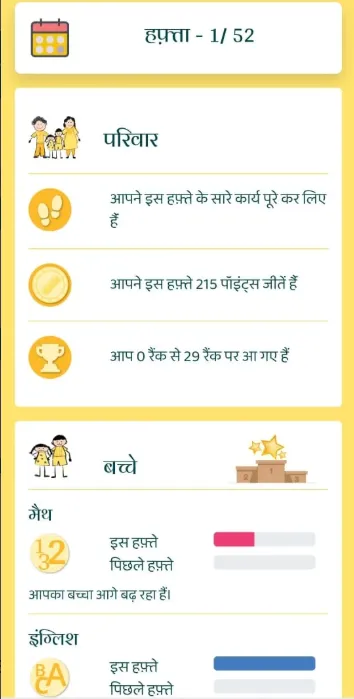
NudgED is a non-profit EdTech organisation focused on strengthening foundational learning by empowering parents in low-income communities to become effective partners in their children’s education. Drawing on evidence that parental engagement is one of the strongest predictors of student achievement, NudgED designs audio- and vernacular-first digital solutions that work on low-end Android phones and in low-connectivity environments. Its flagship programme, Top Parent, is a free mobile app that provides age-appropriate, NCERT-aligned content, play-based activities, and multimedia guidance for parents of children aged 3–8 (now expanding to Grades 4–5), helping them support foundational literacy and numeracy at home even when they have low literacy themselves. NudgED works through a mix of direct-to-parent channels and partnerships with governments, NGOs, and school systems to reach rural and semi-urban families at scale, with a strong emphasis on responsible AI, data minimisation, and child-safeguarding norms. Independent studies and programme evaluations have found that Top Parent improves learning outcomes and parental behaviours, reinforcing NudgED’s mission to build parent-powered learning ecosystems that close India’s foundational literacy and numeracy gaps.
AI Technology Used
Machine Learning, Predictive Analytics, Speech Recognition
Key Outcomes
Efficiency & Productivity
Economic Value Creation
Access & Reach
Inclusion & Equity
Accuracy & Quality Improvement
User Experience & Satisfaction
Resource Efficiency
Top Parent has demonstrated that an AI-powered, vernacular, parent-first solution can significantly deepen parental engagement and improve foundational learning outcomes at scale in low-resource settings. The app has reached over 1.8 million downloads and approximately 910,000 active users across multiple Indian states, with more than 100,000 parents already using the AI chatbot for real-time guidance. Independent evaluations by Central Square Foundation report an average 0.35 standard deviation improvement in children’s literacy and numeracy indicators for the treatment group, with girls making 15% greater gains in advanced numeracy, alongside meaningful shifts in parental behaviour, such as reading with children increasing from 74% to 87% and perceived importance of engagement rising from 90% to 96%. Analysis of 150,000 users by Dr. Ryan Baker (University of Pennsylvania) found that video-based interventions, especially for 7–8-year-olds, are associated with better worksheet performance, while WhatsApp nudges emerged as the most cost-effective engagement channel, yielding around 50% parent engagement and an average of 2.41 in-app actions per user. Together, these findings show that Top Parent not only expands access and equity in early learning but also offers a scalable, responsible AI model for strengthening home–school partnerships in underserved communities.
Impact Metrics
Total reach and active usage of Top Parent among low-income families
Baseline Value
NA Number of users
Post-Implementation
Top Parent has recorded 1.8 million+ app downloads and has more than 910,000 active users. The chatbot has also been used by 100,000+ parents. Number of users
Improvement in children’s foundational literacy and numeracy due to Top Parent usage
Baseline Value
Learning outcomes at baseline as per comparison/control group in independent evaluation
Post-Implementation
0.35 standard deviation average improvement across literacy and numeracy indicators for the treatment group; girls made 15% greater gains in advanced numeracy
Effectiveness of WhatsApp nudges vs IVRS/calls in driving engagement
Baseline Value
Engagement metrics for IVRS/calls
Post-Implementation
WhatsApp nudges achieved ~50% parent engagement and 2.41 average in-app actions, outperforming IVRS/calls
Effect of video-based interventions through Top Parent on learning outcomes
Baseline Value
NA
Post-Implementation
Analysis of 150,000 users over 12 months showed video-based interventions improved outcomes, particularly for 7–8-year-olds, with more video viewing correlated with better worksheet performance
Implementation Context
Top Parent is deployed across multiple states in India, including large-scale use in Hindi-and-Marathi-speaking regions.
Target users are low-income parents and their children aged 3–8 years in rural and semi-urban areas and households
Key Partnerships
State education departments and government schools, Glific, AWS, Central Square Foundation, University of Pennsylvania, and Sambodhi
Replicability & Adaptation
- Retain core product architecture while adapting language, curriculum alignment, and cultural context
- Localise content to align with state or national curricula
- Translate and contextualise examples, stories, and voice assets for local relevance
- Tune speech and text models for local dialects and language variations
- Rebuild AI knowledge bases using locally relevant, curated documents
- Establish partnerships with local governments, NGOs, and community workers
- Introduce app through trusted local touchpoints
- Develop sustained engagement strategies appropriate to context
- Adjust onboarding flows for varying literacy levels and device-sharing norms
- Implement data minimisation practices aligned with local standards
- Design consent flows compliant with local requirements
- Establish governance agreements for data sharing with local stakeholders
- Set up human-in-the-loop escalation protocols for chatbot outputs
- Revalidate all responsible-AI practices against local regulations and safeguarding norms
* The data presented is self-reported by the respective organisations. Readers should consult the original sources for further details.