


XiLing AI: An AI Sign Language Interpretation Solution

China
Other
Accessibility
Implementing Organisation
Baidu
China, Pan-Country
Implementing Point of Contact
Tianmin Long
Contact Person
Contributor of the Impact Story
International Telecommunication Union (ITU)
Year of implementation
2022
Problem statement
Over 27.8 million deaf and hard-of-hearing (DHH) individuals in China require sign language interpretation services, yet fewer than 500 certified sign language interpreters existed in 2023, representing a massive talent gap. Sign language differs fundamentally from spoken Chinese in grammar, structure, and expression, requiring key information extraction rather than direct translation. As a low-resource language, it lacks sufficient data for AI model training. Natural sign language relies on hand gestures, mouth movements, and body language, demanding complex multi-channel synthesis.
Submission Overview
Baidu is a leading Chinese technology company with deep expertise in AI. Its Baidu AI Cloud XiLing digital avatar platform develops solutions for sign language interpretation, leveraging nearly 10 million natural sign language samples for model training, along with proprietary streaming attention models and end-to-end speech recognition achieving more than 15% improvement in cloud-based recognition accuracy.
AI Technology Used
Natural Language Processing, Speech Recognition
Key Outcomes
Access & Reach
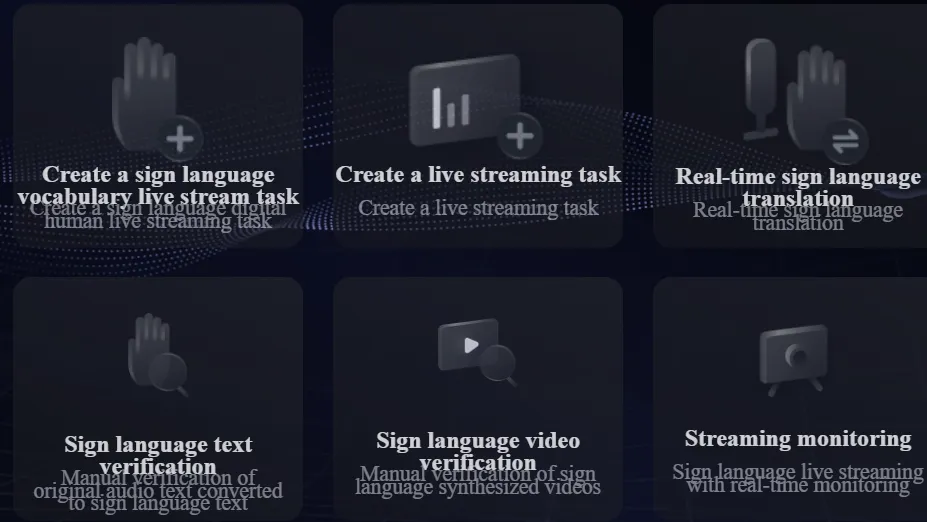
Baidu's XiLing AI Sign Language Platform addresses the critical accessibility gap for over 27.8 million deaf and hard-of-hearing (DHH) individuals in China, where fewer than 500 certified sign language interpreters existed in 2023. The platform provides bidirectional translation between sign language and text/speech/video using digital avatars, achieving over 98% speech recognition accuracy and 98.5% mouth-shape generation accuracy. During the 2022 Winter Olympics, the AI sign language anchors provided 24/7 live broadcasting, garnering over 100 million views.
Impact Metrics
Speech Recognition Accuracy on the AI Platform
Baseline Value
NA
Post-Implementation
Over 98% near-field speech recognition rate on mobile phones
Scale of sign language data corpus used for training the Platform
Baseline Value
NA Number of samples
Post-Implementation
Nearly 10 million natural sign language samples collected for training the AI Platform Number of samples
Mouth Shape Generation Accuracy on the AI Platform
Baseline Value
NA
Post-Implementation
98.5 % accuracy of mouth shape generation was recorded for the AI sign language virtual interpreter solution on the platform
Implementation Context
Deployed in China, across government service counters, hospitals, banks, airports, transportation hubs, educational institutions, and broadcast media, including the 2022 Winter Olympics.
27.8 million deaf and hard-of-hearing individuals in China as well as the general public via accessible public services
Key Partnerships
Tianjin University of Technology School for the Deaf
Replicability & Adaptation
- Expand training datasets to include regional sign language variations and dialects
- Adapt for different national sign languages beyond Chinese Sign Language
- Implement federated learning for privacy during on-device model updates
- Develop lightweight transformer models for diverse hardware platforms
- Partner with local deaf communities and special education experts
The plug-and-play All-in-One Machine enables rapid deployment across diverse settings. Supports online platform deployment within hours or offline plug-and-play, plus integration into TVs, apps, websites, and WeChat mini-programmes. Proven at scale during the 2022 Winter Olympics.
Supporting Materials

* The data presented is self-reported by the respective organisations. Readers should consult the original sources for further details.