


NyayaSakhi-SWATI: AI-Supported Pre-Litigation Guidance for Survivors of Domestic Violence

India
Other
Justice and Governance
Implementing Organisation
NyayaSakhi
India, Maharashtra, Solapur, Latur and other districts
Implementing Point of Contact
Dipali Awasekar
Founder
Contributor of the Impact Story
UN Women
Year of implementation
2022
Problem statement
For many women experiencing domestic violence in India, the primary barrier is not the absence of law but limited access to legal knowledge. Financial dependence, fear of retaliation, stigma and family pressure deter women from approaching lawyers or courts. India has approximately 47.3 million pending cases, with about 58.5% pending for more than one year. Prior to NyayaSakhi-SWATI, no PWDVA-specific judgment corpus or data-driven tool provided early, personalised guidance at scale.
Submission Overview
LAMP is a legal AI research and prototyping initiative. NyayaSakhi-SWATI was developed starting in 2022, creating the NyayaDeepa PWDVA judgment corpus. Early support of INR 100,000 from UN Women contributed to initial dataset creation and validation. The system was subsequently cloud-hosted and integrated into SWATI as the user-facing conversational interface.
AI Technology Used
Machine Learning, Large Language Models, Retrieval-Augmented Generation, Bias-Aware Prompting
Key Outcomes
Access & Reach
Inclusion & Equity
User Experience & Satisfaction
Knowledge & Skills Impact
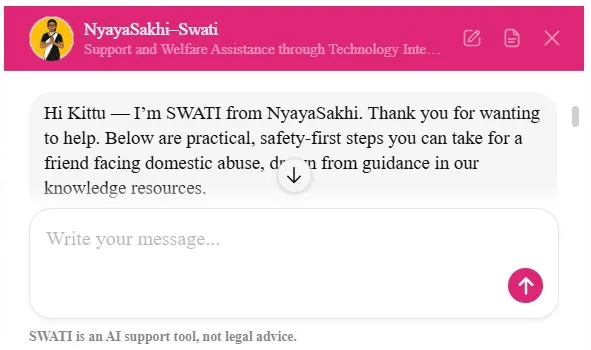
NyayaSakhi-SWATI is India's first LLM- and RAG-powered decision-support assistant for domestic violence survivors, built on NyayaDeepa, India's first corpus of real-world domestic violence judgments from Maharashtra courts. The platform helps survivors clarify their legal options before consulting lawyers, allowing them to avoid unnecessary costs and approach legal consultations with informed questions. NyayaSakhi-SWATI provides accessible legal information that helps women navigate their situations with greater knowledge and agency. During its launch-preview stage, it reached 2,114 women and girls across Maharashtra. 83% of users reported improved understanding of potential legal reliefs and greater clarity on whether to resolve their situation early or proceed through courts.
Impact Metrics
Number of women and girls accessing legal decision-support.
Baseline Value
NA
Post-Implementation
Over 2,114 women and girls were reached during launch-preview stage across Maharashtra.
User Understanding of Legal Reliefs
Baseline Value
NA
Post-Implementation
83 % of users reported improved understanding of potential legal reliefs and greater clarity on whether to resolve early or proceed through courts.
Confidence in Litigation Decision-Making
Baseline Value
NA
Post-Implementation
Women reported increased confidence in deciding whether to pursue litigation, negotiate or seek protection. They also reported reduced time spent searching for legal information and lowered the fear associated with legal processes.
Cost Avoidance
Baseline Value
NA
Post-Implementation
Many women avoided unnecessary legal costs by clarifying options before consulting a lawyer.
Implementation Context
Districts in Maharashtra, India including Solapur, Latur and others with plans for multilingual expansion across India
2114 users across districts in Maharashtra with primary beneficiaries being domestic violence survivors, predominantly women and adolescent girls from low-income and marginalised communities
Key Partnerships
The Maharashtra Court System
Replicability & Adaptation
- Invest early in structured, multilingual legal datasets
- Adapt models to local laws and court practices
- Address digital literacy gaps and trust in AI
- Government support for dataset creation and ethical oversight
- Handle sensitive survivor data with regulatory and ethical care
The approach has potential to scale across India and extend to other women-focused legal frameworks. Adaptation to local languages, court practices and socio-cultural contexts is essential for replication.
Supporting Materials

* The data presented is self-reported by the respective organisations. Readers should consult the original sources for further details.